Showing posts with label American Civil War. Show all posts

Monday, May 30, 2022

Breckinridge's Division


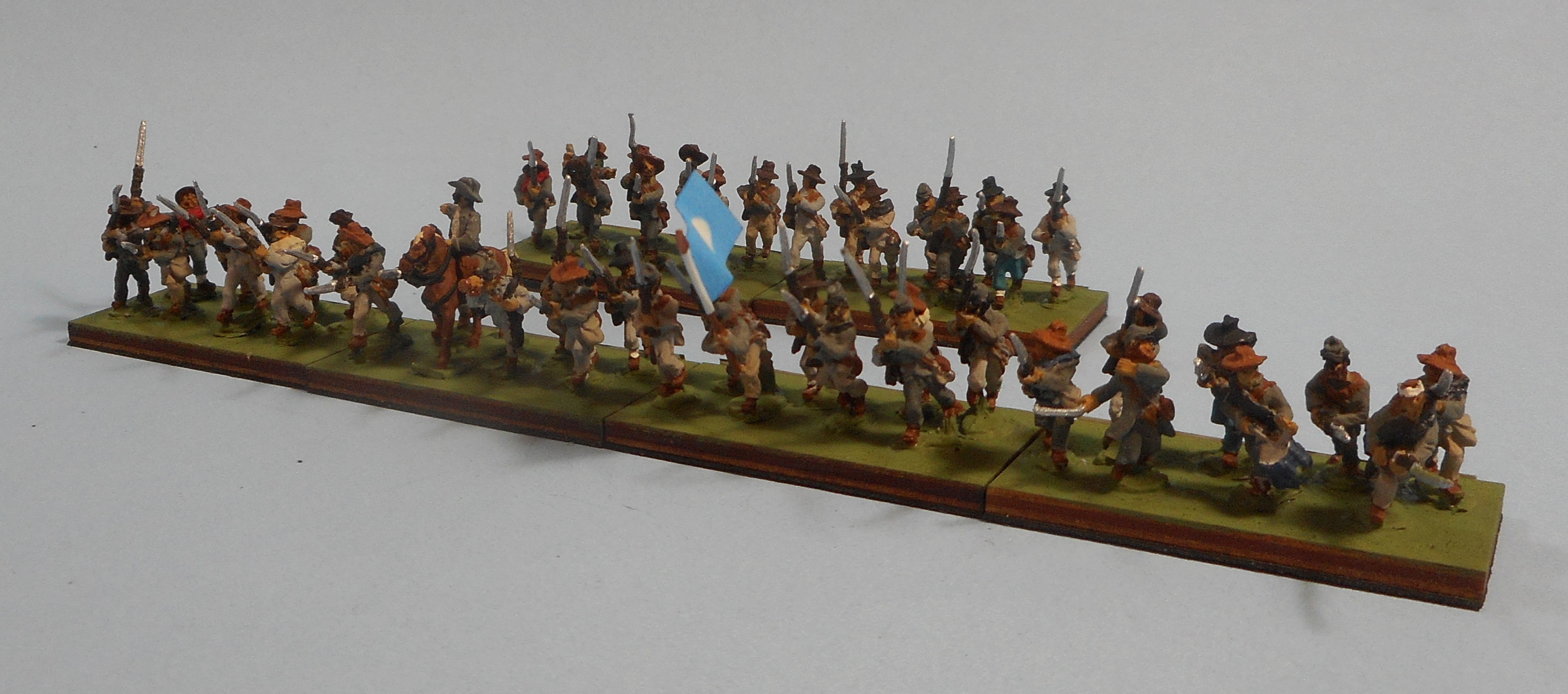
This post shows all of Confederate Major General J. C. Breckinridge's Division of Hardee's Corps.  It was painted by my friend Larry on commission.  He did a great job.

As I've written before, my Confederate forces are loosely organized for Hardee's Corps, Army of Tennessee, during the mid-summer Tullahoma Campaign.

Except for the Battle Honors mounted officers, all the figures and guns are from Old Glory 15s.

Please click on the images for a larger picture.

Division command stand and divisional artillery

Breckinridge and his division flag bearer are on the left and the representation of the division artillery is on the right.

John Cabell Breckinridge was a son of Kentucky and Vice president of the United States under James Buchanan (1857-1861).  He unsuccessfully ran for president as a "Southern Democrat" in the 1860 election that saw Republican Abraham Lincoln elected president.  As one of Kentucky's senators he urged compromise to preserve the union but ultimately failed and fled to the southern controlled portion of Kentucky.  There he was commissioned as a brigadier general in the Confederate Army and then promoted to major general.  During the 1863 Tullahoma campaign his division served under General Joe Johnston in Mississippi against Major General U.S. Grant's offensive.  Recalled to Tennessee, Breckinridge's division participated in the battles at Chickamauga and Chattanooga.  For my purposes, this division did not go to Mississippi but stayed in Tennessee.

Breckinridge's division artillery consisted of three batteries.  Cobb's Battery, or the 1st Kentucky Artillery, started its service with four M1841 6-pound smoothbore guns and two M1841 12-pound mountain howitzers.  By July 1863 it had four M-1857 12-pound Napoleon guns.  Mebane's Tennessee Battery had four 12-pound howitzers.  Slocomb's Louisiana Battery had four 12-pound Napoleon guns and two James rifled guns.  For the purposes of the "On to Richmond!" rules all of these batteries are represented by one smoothbore gun.

Helm's Brigade

Helm's "1st Kentucky" or "Orphan" Brigade

The 1st Kentucky Brigade was originally commanded by Breckinridge.  Brigadier Benjamin Hardin Helm took over command in January 1863 and led the brigade until his death at Chickamauga.  The brigade was called the "Orphan" brigade after its recruiting ground in Kentucky was lost to the Union.  It served with the Army of Tennessee until the end of the war.  For the Tullahoma campaign it consisted of the 41st Alabama and the 2nd, 4th, 6th, and 9th Kentucky Regiments.  With a strength of about 1500 men, it is represented by five stands of figures.

Adams' Brigade

Adams' Brigade

Commanded by Brigadier General John Adams, this brigade consisted of the 32nd Alabama, and the  13th/20th Louisiana, 16th/25th Louisiana, and 19th Louisiana Infantry Regiments, and the  14th Louisiana Sharpshooter Battalion.  With a strength of about 1200 men, it is represented by four stands of figures.

Stovall's Brigade

Stovall's Brigade

Commanded by Brigadier General Marcellus Stovall, this brigade is the smallest of the three in Breckinridge's Division.  For this campaign it consisted of the 1st/3rd Florida, 4th Florida, 47th Georgia, and 60th North Carolina Infantry Regiments.  With a strength of about 900 men, it is represented by 3 stands of figures.

This division completes my Confederate troops for the time being.  Now off they go to battle!


Saturday, May 14, 2022

Bowen's Command Group and Division Artillery


Major General John S. Bowen commanded a two-brigade division in the Department of Mississippi.  While his division was part of Pemberton's "Army of Mississippi," in my "imagi-nation" Civil War it and Forney's Division were transferred to central Tennessee prior to Grant beginning his campaign to take Vicksburg.  His First Brigade was featured in a previous post.  The second brigade (Green's) is being painted.

Bowen's command stand on left and division artillery on right

John S. Bowen began his Civil War career as a commander of Confederate Missouri infantry.  He was promoted to Brigadier General in March 1862 and led his brigade at Shiloh and Corinth before it was assigned to the Vicksburg garrison.  His efforts at Grand Gulf and Raymond led to him being promoted to major general and put in command of a division which he led at Champion Hill and then into Vicksburg.  He died of dysentery after the surrender.  Of course in "my world" his division was transferred to Tennessee and joined Hardee's Corps in the Army of Tennessee after Stone's River.

Bowen's command stand - a Battle Honors mounted general and an Old Glory 15s flag bearer

Bowen's division artillery consisted of three batteries - the Appeal (Arkansas) Battery (two 3" rifles and two 12-lb howitzers) and Guibor's (four 6-lb guns) and Landis' (two 12-lb Napoleons and two 24-lb howitzers) Missouri Batteries.  It is represented as having all smoothbore guns.  In the "On to Richmond!" rules, Confederate gun stands consist of 12 guns.

Old Glory 15s gunners and gun

The rest of the division, Green's Brigade is being painted and will be posted later.  The entire division, as well as all my Union and Confederate troops, will receive their "baptism of fire" in a game next Saturday.


Saturday, May 7, 2022

Cockrell's 1st Missouri Brigade


Cockrell's 1st Missouri Brigade of Bowen's Division has now joined my Confederate forces.  Although it is assigned to Hardee's Corps, this brigade was actually part of Pemberton's "Army of Mississippi" during the spring and summer of 1863, fighting at Champion Hill and the siege of Vicksburg.  Even though formed from Missouri State Guard, it was one of the hardest fighting brigades in the Western Theater.  I decided to modify my order of battle for Hardee's Corps to include this brigade, presuming that it and its companion brigade, Green's, both of Bowen's Division, had been moved from Mississippi to Tennessee to oppose the Union forces there before Grant started his active campaigning to get around the southern flank of the Vicksburg defenses.

The brigade in its "reinforced line" formation.

Commanded by Colonel Francis Cockrell, it consisted of the 1st, 2nd, 3rd, 5th, and 6th Missouri Infantry Regiments.  It was about 1,500 rifles strong in the spring of 1863, translating to five stands for the "On to Richmond!" rules I'm using.  These Old Glory 15s figures are painted in the "drab" uniform with which this brigade was outfitted.  They are mounted on 2" x 1" Litko 8mm bases.

The brigade in march column, showing one of the regimental flags used by Missouri forces.

I tried a different basing technique with this brigade, mixing my Americana Hauser medium green paint with Delta Ceramcoat Texture Builder to try and add some dimension to the bases.  Although it was thick when I applied it, the mixture flattened as it dried.  And it got glossy so I'll need to either put some matte glaze or some more green paint over it.  Oh well,  live and learn.

I also completed enough 'morale markers' for all of the brigades.  "On to Richmond!" uses a system of disrupting morale markers to record the effects of weapons fire and close combat.  I represent these with 1" hex bases and a casualty figure.

Confederate and Union morale markers.

Brigades can accumulate up to three morale markers, represented by the number of dots on each of the three faces of the hex marker.  The more markers received, the less effective a brigade can be.  Brigades with a morale marker must check on the morale table at the beginning of their division's activation even if they will not perform any action.  The brigade must follow the results immediately even if it means the brigade falls back or launches a charge against the nearest opponent.  Makes things interesting as one can never be sure what a 'shaky' brigade might do.

Next up in the painting queue is Bowen's Division command stand and the divisional artillery 'battalion" followed by Green's Brigade.

Saturday, April 23, 2022

Wood's Brigade of Cleburne's Division


This 15mm ACW Confederate brigade has been "hanging fire" for many, many months (since the fall of 2019).  But now its time has come, energized because I need more Confederate forces for my upcoming game at the regional Bayou Wars convention in June.  They are 15mm Old Glory figures and are based for the "On to Richmond" rules.  Please click on the pictures for a larger image.

Wood's Brigade, commanded by Brigadier General Sterling A. M. (Sam) Wood is a mixed Alabama and Mississippi brigade in Major General Patrick Cleburne's Division of Hardee's Corps in the Army of Tennessee.  It is the last of Cleburne's three brigades to be painted.

The brigade consists of the 16th Alabama, 33rd Alabama, and 45th Alabama Infantry Regiments; the 18th Alabama Infantry Battalion; the combined 32nd/45th Mississippi Infantry Regiment; and the 15th Mississippi Infantry Battalion, all told some 1,800 men.

The other units of Cleburne's division are Polk's and Deschler's Infantry Brigades and an artillery battalion (Calvert's Arkansas, Douglas' Texas, and Semple's Alabama Batteries).

I now have six Confederate infantry brigades with two more in the immediate pipe-line.  They'll be fighting against twelve Union infantry brigades.  The game will be a "what-if" scenario from the June 1863 Tullahoma Campaign.  More details to follow.


Thursday, November 26, 2020

ACW Union XIV Corps Completed


Thanks to a good friend, all of the units of the Union XIV Corps are now painted and based.  Commanded by Major General George Thomas, the XIV Corps was, in my opinion, the elite corps of the Army of the Cumberland from the beginning of the Tullahoma Campaign  through the smashing of Bragg's Army of Tennessee at the Battle of Missionary Ridge.  I've replicated in 15mm for the "On to Richmond" rules.  Please click on each image for a larger picture.


For "On to Richmond" each maneuver unit is either a brigade of infantry or cavalry or a grouping of 12 artillery pieces.  Each infantry stand replicates about 300 men.

The last part of the corps to be completed was Brigadier General John Brannan's 3rd Division.

Brig Gen Brannon (left) and the divisional artillery (right), consisting of D Company, 1st Michigan Light Artillery and C Company, 1st Ohio Light Artillery

1st Brigade (82nd Indiana and 17th, 31st, and 38th Ohio) in line of battle.

1st Brigade in a reinforced line of battle.

2nd Brigade (10th and 74th Indiana, 4th and 10th Kentucky, and 14th Ohio) in reinforced line of battle.
.
3rd Brigade (87th Indiana, 2nd Minnesota, and 9th and 35th Ohio) in reinforced line of battle.


And the entire XIV Corps in its "barracks box" with the corps command and artillery in the left center, the 1st Division on the upper left, 2nd Division on the lower left, 3rd Division on the upper right, and 4th Division on the lower right.


The only unit of the corps not yet included is Colonel John Wilder's 1st Brigade, 4th Division, the "Lightning Brigade."  This brigade was a mounted infantry unit and was used by Major General Rosecrans as a mobile striking unit along with some of the army's cavalry.  The Lightning Brigade and Colonel Robert Minty's 1st "Saber" Brigade, 2nd Cavalry Division are still "being raised."  They will join the XIV Corps at a later date.


Now on to the Confederate forces who will oppose them.  I've only been working on this project since January 2016 and hope to have it completed before the summer of 2021.  That's only about 5-1/2 years, longer than the American Civil War lasted.

Monday, September 23, 2019

15mm Pegram's Cavalry Brigade

As I mentioned in a previous post, I have now changed my Confederate cavalry basing from their temporary "Fire and Fury" basing to my permanent "On to Richmond" basing.


Here is the still to be completed brigade of Confederate cavalry commanded by Brigadier General John Pegram.  It consisted of the 1st and 6th Georgia, 6th North Carolina, and 10th Confederate Cavalry Regiments and Rucker's (cavalry) Legion.  The brigade was commanded by Pegram until Bragg formed a second cavalry corps to be commanded by Brigadier General Nathan B. Forrest.  At that time Pegram was elevated to a division command and turned his brigade over to Brigadier Henry B. Davidson.

The brigade is incomplete, missing 7 mounted and 3 dismounted stands.  They will be procured in the near future to complete the brigade.  Another horse-holder stand will be created out of on-hand figures.  The horse-holder stands will be used to show the position of the brigade's horses when the troopers are functioning in their dismounted capacity.

I also plan on raising a second Confederate cavalry brigade in the near future but an unsure of which one it will be.  There were eight cavalry brigades in the Army of Tennessee at the time of the Tullahoma-Chattanooga-Chickamauga campaign which is the timeframe I'm using to raise my Union and Confederate forces.

Sunday, September 22, 2019

Polk's Brigade of Cleburne's Division

While I was painting Confederate cavalry for our just completed Chickamauga game, I also finished painting and basing another brigade for Hardee's Corps of the Army of Tennessee.

Polk's brigade of Cleburne's Division
This is the brigade commanded by Brigadier General Lucius Polk (no relation to the Bishop) and consisted of the 1st Arkansas, 3rd/5th (consolidated) Confederate, and 2nd, 35th, and 48th Tennessee Infantry Regiments.  The figures are 15mm Old Glory miniatures and are dressed in my rendition of a "drab" colored uniform which was common in the Confederate west.  They are based for the venerable "On to Richmond" rules.

Now I just have to paint Wood's Brigade and I'll be completed with Cleburne's Division.  That will put my half-way through painting my Confederate infantry forces, leaving just the three brigades of Breckinridge's Division and the two brigades of Bowen's Division (borrowed from Pemberton's command in Mississippi).

15mm Confederate Cavalry

I should have uploaded this several days ago.  This is almost all my contribution to our just completed Chickamauga game (Saturday, Sep. 21).

The four mounted stands plus more than enough horse-holder stands and four of the ten required dismounted stands.

They are a mix of various 15mm manufacturers.  Although currently mounted for "Fire and Fire" they will be remounted this coming week as Pegram's Cavalry Brigade of the Army of Tennessee.

Tuesday, August 27, 2019

15mm Union Cavalry

My friend Electric Ed is developing a club game for us to play on September 21.  He is using the "Fire and Fury" rules with the 1st Day of Chickamauga as the setting.  But the challenge is that Ed doesn't own any 15mm ACW figures.  So three of us are helping him out - Phil with Union infantry and artillery and most of the Confederate cavalry, Larry with Confederate infantry and artillery, and me with Union cavalry and the balance of the Confederate cavalry.  So for the past month or so, I've been working on painting enough Union cavalry for 11 mounted stands (at 2 figures per stand), 8 dismounted stands (at 3 figures per stand), and 3 horse holder stands.

I'm using almost all of my Union cavalry figures in this endeavor from several different manufacturers.  Although they are currently based for "Fire and Fury" rules, they will eventually be permanently based for the "On to Richmond!" rules.

Eleven stands of Union cavalry which will later be divided into Wilder's mounted infantry ("Lightning") brigade and Minty's cavalry ("Saber") brigade.

Eight stands of dismounted cavalry and three stands of horse holders, which also will later be divided into Wilder's and Minty's brigades.
I know that the dismounted command stand's flag is incorrect for a cavalry unit, but it will go to Wilder's Brigade which carried the standard Union infantry colors.

Now to get to work on the Confederate cavalry, which will be reported separately.


Wednesday, May 8, 2019

Hardee, Cleburne, and Artillery

And some more of my 15mm American Civil War project completed.

My Confederate force is based upon Lieutenant General William J. Hardee's Corps of the Army of Tennessee at the beginning of the Tullahoma Campaign in the summer of 1863.  Here we have Hardee's command stand as well as that of Major General Patrick Cleburne and Cleburne's division artillery.

Lt Gen Hardee's corps command stand with three figures on a 40mm round base.

Maj Gen Cleburne's division command base on a 25mm round base.

Cleburne's Division artillery, consisting of Calvert's (Ark.), Douglas' (Tex.), and Semple's (Ala.) Batteries.
[Although depicted armed with rifled guns, they actually had a variety of smoothbore guns.  This will have to be changed!]
The figures are Battle Honors mounted and Old Glory 15s foot figures.  The gun is from Old Glory 15s.

Organized for the "On to Richmond" rules which calls for an artillery stand to represent approximately 12 guns.  For the Confederates, that's three of their 4-gun batteries which was the standard for the Army of Tennessee in 1863 and 1864.

Monday, April 15, 2019

Deshler's "Texas" Brigade

Finally, after many fits and starts, I've completed another Confederate brigade for my 15mm ACW forces which are based on portions of the Union Army of the Cumberland and Confederate Army of Tennessee during the spring and summer of 1863.

This one is the "third" brigade of  Pat Cleburne's division of Hardee's Corps, Army of Tennessee.  Commanded by Brigadier General James Deshler, it consisted of the following regiments:  19th/24th Arkansas, 6th/10th Texas Infantry/15th Texas cavalry (dismounted), and 17th/18th/24th/25th Texas cavalry (dismounted).  After Deshler was killed at Chickamauga, the brigade command was assumed by Brigadier General James A. Smith and later by Colonel, then Brigadier General, Hiram Granbury.

Deshler's Brigade in a reinforced line formation
 My 15mm ACW forces are organized for the "On to Richmond" rules where the basic maneuver unit is the brigade.  Each stand depicts about 300 infantry.  With Deshler's Brigade being about 1800 strong, there are six stands in it.  The reinforced line is one of the formations allowed in the OTR rules.


Here's another view showing the "Cleburne" style flag carried by the regiments of the brigade.  Even though there are three combined regiments in this brigade, I only use one flag.  The miniatures, with two exceptions, are 15mm Old Glory figures.  The two exceptions are the mounted and foot officers.

Here's a close-up of one of the stands.  I've depicted the brigade in newly issued uniforms from the Columbus, Georgia, depot.  It is a light gray/brown with infantry blue cuffs.  I used Folk Art Barn Wood as the base uniform color with Americana Uniform Blue on the cuffs.  For more information on this uniform, as well as pictures of surviving examples, see Geoffrey Walden's excellent on-line article "Confederate 'Columbus Depot' Jackets."  This uniform will also equip another of my soon to be painted Confederate brigades, Helms' "Orphan" Brigade of Breckinridge's Division.

Monday, March 11, 2019

By damn! Those are Regulars!!

With apologies to British Major General Phineas Riall.

I finally completed the last brigade in Brigadier General Absalom Baird's 1st Division of Major General George Thomas' XIV Corps, Army of the Cumberland.  This is Brigadier General John King's 3rd Brigade, "The Regulars."  It was the only regular US Army brigade in the Army of the Cumberland, composed of the 1st Battalion, 15th US Infantry, 1st Battalion, 16th US Infantry, 1st and 2nd Battalions, 18th US Infantry, and 1st Battalion, 19th US Infantry.  Although they were part of the regular establishment, not volunteer regiments, they were no better than the volunteers who made up the vast majority of Baird's 1st Division.

King's Regular Brigade in attack column

A "bird's eye" view of the brigade
The figures are all Old Glory 15s with Warflag paper flags, mounted on Litko bases.

They are organized for the "On to Richmond" rules where the basic infantry maneuver unit is the brigade.  Each stand is approximately 300 real men.

They join the other two brigades of Baird's division, completing three of the four divisions in Thomas famed XIV Corps.  I still have to paint Brigadier General John Brannan's 3rd Division of three brigades to complete the corps.

But now I've turned to catching up my Confederate force by beginning on Major General Patrick Cleburne's Division of Lieutenant General William J. Hardee's Corps.

My American Civil War forces are from the 1863 Union Army of the Cumberland and Confederate Army of Tennessee who contested central Tennessee in the Tullahoma Campaign leading to the decisive battle of Chickamauga.

Monday, November 12, 2018

Union Reinforcements

I'm continuing to slowly add to my 15mm American Civil War forces, this time some Union elements.  My ACW focus is central Tennessee with the Union XIV Corps of the Army of the Cumberland facing a modified Hardee's Corps of the Army of Tennessee.

Please click on the photographs for an enlarged image.

The figures are all 15mm Old Glory miniatures.  The units are organized for the "On to Richmond" rules.

Major General George Thomas' command group, XIV Corps

Brig Gen Absalom Baird, 1st Division command group, XIV Corps, and his division artillery
(4th Indiana Battery and H/5th US Artillery, armed with rifled guns)

Brig Gen John Starkweather's 2nd Brigade, 1st Division, XIV Corps
(24th Ill, 79th Penn, and 1st and 21st Wisc Regiments)
More will slowly be added.


Friday, September 1, 2017

From ACW to FPW

Although I haven't made any posts lately, I have been painting away on my Franco-German War (as I call it) figures as well as mounting some ACW pictures painted by my friend, Larry the Marine.

After hosting a FPW game in late July, I got on a painting kick to finish some French and Prussian figures.  I already had one battalion of the French Republican Volontaires de l'Ouest painted.  I bought enough figures at Historicon to complete the other two battalions of the regiment.  Here is the 1st battalion, minus its flag which has since been prepared and mounted.


The Volontaires de l'Ouest were formed from the old Pontifical Zouaves and were probably one of the better regiments in the Republican armies to the south of Paris.  In my army, they form part of the XV Corps, Army of the Loire.  The figures are actually Union zouaves from Sash & Saber's ACW line since I couldn't find any appropriate zouaves wearing kepis.

Continuing with the FPW theme is the headquarters of IX Korps, 2nd Prussian Army which in my army is deployed south of Paris to keep the Loire rabble from interrupting the siege of Paris.


This HQ group utilizes a mix of Foundry, Castaway Arts, and Irregular (I think) figures to depict General der Infanterie Albrecht Gustav von Mannstein and his battle staff.  His uhlan aide is handing him a dispatch from a subordinate commander while his artillery staff officer keeps track of the battle through his binoculars.

Turning to the American Civil War, my gaming friend Larry the Marine recently painted a division of Union troops for me.  I'm organizing Union and Confederate forces for the Middle Tennessee campaigns of 1863 using the On to Richmond rules where each brigade is composed of 3 to 8 stands of figures.  Here is Beatty's 1st Brigade, Negley's 2nd Division, Thomas' XIV Corps, Army of the Cumberland.

Beatty's battleline ready to give fire into the attacking Confederates.
Right flank of the line.
These are Old Glory 15s Union figures from which I have trimmed the bayonets as they are in firing poses.  I use 8 figures on all the bases of each brigade except for one upon which I place a mounted officer (the brigade commander) and 6 figures.

I've made previous posts showing some of my first Union and Confederate units which you can see by clicking on the "American Civil War" label in the list below.


Friday, August 26, 2016

15mm Confederates and 25mm Medievals

My August additions have been a little varied -- 15mm Confederate infantry and 25mm Medieval cavalry!

First the Confederates.  I purchased a nice little collection of painted 15mm Confederate infantry a short while ago and organized some of them into another brigade for my somewhat made-up Tullahoma Campaign forces.  To these already painted figures I added a mounted officer - Brigadier General Stephen Dill Lee.  Lee, as many of you may know, started out as an artillery officer, eventually commanding some of the artillery at Vicksburg.  But during the beginnings of the campaign that would eventually see it fall, he was given command of an Alabama brigade. 

As a graduate of Mississippi State University, I just had to include S.D. Lee in my Confederate forces as he was a long-time President of the university (or Mississippi Agricultural & Mechanical College as it was know then).  Plus he was a long-time president of the Board of Directors of the Mississippi Department of Archives and History from which I recently retired after 22 years of service.

I've replicated it for "On to Richmond" rules with a strength of approximately 1200 men.  All I had to do was repaint several of the figures trousers and some of the blanket rolls.

Lee's Alabama Brigade - 20th, 23rd, 30th, 31st, and 46th Alabama Regiments
Although in reality this brigade was besieged in Vicksburg and captured when the city surrendered, in my made-up Tullahoma campaign, it was sent from Mississippi to reinforce the Army of Tennessee.  As an independent brigade, Lee's can be attached to any of the Confederate divisions.

As part of "On to Richmond" brigades suffer casualties two ways - outright kills and disruptions.  Of course outright kills result in the removal of stands, but disruptions incur various combat and fire penalties.  The rules recommend some type of marker to indicate the up to three disruptions a brigade can suffer.  I decided to use a hexagon base with a casualty figure and one, tow, and three dots on the sides to indicate the degree of disruption.  This picture shows Lee's Brigade with two disruptions.

Lee's Brigade with a disruption marker showing two disruptions.

And finally, I came across some vintage Ral Partha "true" 25mm mounted sergeants that I bought a couple of years ago.  As they were already painted to a nice standard, all I had to do was touch them up and glue them to their 40mm x 20mm metal bases.  This unit of 6 mounted sergeants can now be used for three different rule sets - the venerable "Rules by Ral," the derivative and expanded "Lion Rampant," and the relatively new "To the Strongest!"  Can't get much better usage than that, can you?

I haven't come up with a name for these rascals yet, but they do look very martial.


Monday, August 1, 2016

Turchin's Brigade, 4th Division, XIV Army Corps

Today I welcomed Brigadier General John Turchin's 3rd brigade of Major General Joseph Reynolds' 4th Division, Major General George Thomas' XIV Corps, Army of the Cumberland to Col Campbell's Barracks to join my very slowly expanding Union forces.  John Turchin was a Russian émigré from the Don District of the Ukraine who had been a Russian officer.  More information about him can be found here.


Turchin's Brigade, at the start of the 1863 Tullahoma Campaign, in which I place my forces, consisted of the 18th Kentucky and 11th, 36th, and 92nd Ohio Infantry Regiments.


These 15mm figures, except for the mounted officer, are Old Glory 15s, while the mounted officer is a Battle Honors figure.  The figures are mounted for the "On to Richmond" rules in which the basic maneuver unit is an infantry or cavalry brigade of 3 to 10 stands, each stand representing approximately 300 actual soldiers.

Sunday, April 10, 2016

Forney's Division, CSA

The command stand for Forney's Division, CSA, was completed Friday night.  And here it is in all its glory:

Major General John Forney and his divisional flag bearer.
Each of my Union and Confederate divisions will have a mounted officer and a standard bearer carrying a flag emblematic of the division.  For the Union forces, Thomas' XIV Corps of the Army of the Cumberland, they will be the standard divisional flags for XIV Corps.  For the Confederate forces, Hardee's Corps of the Army of Tennessee, they will be more "generic" but still emblematic of the division.  Here since Forney's Division has brigades who formerly were under Earl Van Dorn's command its command stand uses a "Van Dorn" flag.

Organized for the "On to Richmond" rules, Forney's Division has two brigades and an artillery battalion.

Forney's Division with Hebert's Brigade on its right, the artillery battalion in the center, and Moore's Brigade on its left.

Only two brigades strong, Forney's Division will have to be careful when it engages the stronger Union divisions (normally three brigades strong), but I anticipate it may eventually be reinforced with a third brigade sometime in the future.

Next up to paint will be Major General Joseph Reynold's 4th Division, XIV Corps, Army of the Cumberland.  Reynold's Division only has two brigades (Robinson's 2nd and Turchin's 3rd) as Wilder's 1st Brigade is mounted and is constantly being appropriated by the army commander for special missions.  As with Forney's Division I anticipate Reynolds will be reinforced by a third brigade, probably Reeves' Independent Brigade.  Once I get Reynold's Brigade painted and based I'll be able to do some more intensive "playing" with the rules.


Thursday, April 7, 2016

Hebert's Brigade and Forney's Divisional Artillery

Well it has been more than a month since my last post.  "Equipping" Hebert's Brigade was much slower than I thought it would be, but it is finally done.

Hebert's Brigade of Forney's Division has a special significance to me as it contained the regiment in which my great-grandfather, Wesley Washington Pitts, served.  The 36th Mississippi Regiment was organized shortly before Shiloh but didn't join Beauregard's army until after the battle.  They participated in the battles of Iuka and Corinth in the fall of 1862, then were assigned to the garrison at Vicksburg where they stayed until the surrender on July 4, 1863.  Reconstituted in west Alabama after being exchanged, the regiment joined the Army of the Tennessee as part of Bishop Polk's Army of Mississippi reinforcements, fighting from New Hope Church (May 1864) through the disasters at Franklin and Nashville.  It then was assigned to the garrison at Mobile where it ended the war.

In my "imagination" Civil War world, Forney's Division (Hebert's and Moore's Brigades, plus artillery) was transferred from the Department of Mississippi and East Louisiana (Pemberton's command) as reinforcements for the Army of Tennessee, joining them just in time for the Tullahoma campaign.

Hebert's Brigade consisted of the 3rd and 21st Louisiana Infantry Regiments; the 36th, 37th, 38th, and 43rd Mississippi Regiments; and the 7th Mississippi Battalion.  Represented here for the "On to Richmond" rules it has approximately 1500 men.


Hebert's Brigade in single line of battle.  Since the brigade was originally under Van Dorn's command, I gave it a "Van Dorn" style battle flag.

And the brigade in that "new fangled" reinforced battle line with about 40% of the regiments in the second line.
Forney's divisional artillery consisted of the following batteries: A Company/1st Mississippi Light Artillery, C Company/2nd Alabama Artillery, and Sengstak's Alabama Company.  Each battery only had 4 guns so with the "On to Richmond" organization, those 12 tubes are represented by one gun model and 4 gunners.  As best as I can tell, the majority of the guns in these three batteries were smoothbores.  The gun model is painted as a 12-lb Napoleon gun-howitzer.

Forney's Division artillery "battalion"
And here is a shot of Hebert's Brigade and the divisional artillery battalion deployed to engage the Yankees.


Still to be painted is the divisional command group for Forney's Division, Major General John Forney.  Hopefully it will be done much quicker than Hebert's Brigade.

All of the figures and the gun are from Old Glory 15s.  http://oldglory15s.com/

Wednesday, March 9, 2016

Moore's Brigade versus Reeves' Brigade (ACW)

Just some snaps of my first two 15mm ACW units facing off on the battlefield.

Moore's Confederate Brigade advances from a copse of woods.

Across the field, Reeves' Union Brigade is also advancing.
And they meet in the middle.  Moore's Confederate brigade is in a standard formation with all regiments in a single line.  Reeves' Union Brigade is in that "new fangled" reinforced line where some of the regiments are in a second line as supports.

In the "On to Richmond" rules the reinforced line has a slight advantage in close combat.  If the first line is defeated then the attacker must fight the second line immediately.  As the attacker will now be disorganized, the second line will get a small bonus.  I haven't tested this out yet on the battlefield.
The scenery is courtesy of my son's Battle Mech game last Saturday.  It is actually jungle foliage made from plastic aquarium plants that I've cut into irregular shapes.  But it worked as a backdrop for these "pick-up" snaps.

My second Confederate brigade is coming along, albeit a little slowly.  I'm hoping to have it finished by the weekend, along with the division command group and the supporting artillery.