Showing posts with label WW2. Show all posts

Saturday, August 21, 2021

Memoir 44 - Battle of Prokhorovka (Kursk, July 1943) 'Overlord' Version


As I stated in my previous post, this was a massive game with 25 units per side.  This particular battle was the one of the largest tank actions in modern history.  Some say the largest but others, including historian David Glantz, say it was the Battle of Brody in 1941.

Anyway, it was the largest one we've fought.  The German 2nd SS Panzer Korps had (or would have had if we would have counted properly) 48 armored vehicles and 44 infantry stands [92 in 14 armored and 11 infantry units].  The Soviet 5th Guards Tank Army had 47 armored vehicles, 32 infantry stands, and 4 artillery stands [83 in 15 armored, 8 infantry, and 2 artillery units].  As an interesting note, the 5th Guards Tank  Army went on to increase its stature and ended up as one of the Soviet armies in the Belorussian Military District where it formed part of the strategic second echelon armies against NATO forces in western Germany during the Cold War.

Now on to the battle.  There were six of us which just the right number as the Memoir 44 board is divided into three sections -- left, center, and right.  Jay (Lord Sterling), Ed, and Steve started out with the Germans while Mark, Phil, and I had the Soviets.  Jay and I were the two overall commanders who got to hand out the action cards.  In the 'Overlord' version, each side can play up to three cards per turn and at the end of each turn draws two replacement cards as long as your "hand" doesn't exceed your starting number, which for this scenario was ten each.  Victory was measured in units killed with 12 being the magic number.

I only took four pictures at the start of the first game, but they will give you a good appreciation of the games.  We played in my church's library on a table that is 10' long and 4' wide, which was just about perfect for the layout.  The two battle mats are from Cigar Box Battle [shameless advertisement] and were printed with 4" hexes.  I've also used these for a large number of Commands & Colors - Medieval battles.

Please click on an image to get a larger picture.

Here is a long view of the entire battlefield.  The Russians are on the left (Where else would they be!) while the Germans on on the right (Undsoweiter for them as well).  As you can see with the Russian tanks in the foreground, there are four 3-tank units with one of them down to only one tank as is the German tank unit directly in front of it.  Prokhorovka is in the middle of the battlefield on the left beyond the stream.

Here we are looking towards the German attack from behind the Russian center.  As you can see, we're using whatever we had available, including armored vehicles that had not even been fielded yet.  Here also you can see the losses.  And some of the cards available to me as the Russian commander.  Plus you'll notice a visitor to the battlefield.

A good view of the German command team with Steve pondering the mass of Soviet tanks bearing down on him while Jay (center) and Ed try to decide who gets what command/combat card.

Another shot of the Doctor facing down the German panzers.  But unfortunately for the Soviets he was neutral in the battle.

Things began going downhill swiftly for the Soviets who ended up losing with 5 or 6 victory medals to the 12 that the Germans got to win the first game.

At this point we reset the battlefield, went to lunch (at the Quiznos sandwich shop down the street, and returned, switching sides.  Then Mark, Phil, and I showed that since we lost with the Russians in the first game, we could just as easily lose with the Germans in the second, 12 Soviet victory medals to our 9.  It was a little closer but still no "cigar."

Overall it was a fun game and we plan on doing some more of these 'Overlord' variants, maybe one from the Battle of the Bulge.  There are many. many scenarios for Memoir 44 and all its iterations on the Days of Wonder web site.


Friday, August 20, 2021

Clankety, Clank, I Am a Tank!


My good wargaming buddy Lord Sterling and I, in response to a fellow gamer's request, are running a large Memoir 44 game using 15mm miniatures on Saturday.  The scenario is the tank battle at Prokhorovka (Kursk, July 1943) pitting the German SS Panzer Korps against the Soviet 5th Guards Tank Army.

Then we realized we didn't have enough German armor for the scenario so we ordered two boxes of Flames of War 15mm German tanks (one of Pz-IV H and one of Pz-VIa) from Noble Knight Games.  They had them in the post to us very quickly and they arrived on Tuesday at my house.  I immediately started putting the tanks together.  This was the first time in decades that I've assembled a plastic kit (except for some buildings) so my first two, even following the instructions on the Flames of War web site, were rather slap-dash.  But I quickly got the hang of it, assembling three Pz-IVs and all five Pz-VIs.  I left the other two Pz-IVs to Lord Sterling.

My first (and partially painted) Pz-IV H

Not having the "right" paint colors, I was forced to improvise, assisted by a Vallejo to Craft Paints conversion chart I had run across several years ago.

The first Pz-IV H and three unpainted PZ-VIs

Hand painting was too slow as we needed a quick turn-around so I went to a spray paint - Krylon flat camouflage tan.  That seemed to do the trick in representing the elusive German dunkelgelb (dark yellow) basic paint scheme from the factory.

And here are my results.

Three Pz-IV H tanks.
One handpainted with a mix of craft paint (desert sand and butter pecan), one sprayed with an almost empty can of flat tan, and one with the Krylon flat tan.

And the five Pz-VI Tigers, all painted with the Krylon flat tan.

In addition, I did some detailed painting of the bow machineguns, tracks, and a few other items.  With time being short I did not attempt any camouflage paint addition (a combination of dark olive green and red brown) that the German fieldtroops applied.  My thought was these tanks had just arrived fresh off the train from the factory in Germany and were rushed into the field.  That sounded good to me.

Of course I found out after we had already committed ourselves that the requesting gamer would not be able to come to the game.  Oh well, his loss!

So with this quick diversion from the Franco-German War (1870-1871) to the "Russo-German" War (1943) done, I will gratefully return to the 19th Century to complete several more batteries of Prussian artillery for the IX Armeekorps in 1871.


Sunday, May 30, 2021

Introduction to "Company of Heroes" Boardgame


At our regular "5th Saturday" game on May 29th, we gathered at Bryan's house in his "man cave" building for an introduction to the "Company of Heroes" board game that he helped develop.

 https://www.companyofheroesbg.com/

This is a two-level game with tactical-level play happening on the game board as the players pit their infantry squads supported by various other types of combat commands against each other and on the 'strategic' level as you decide what new units to build using the resources that you gain through the tactical play.  This 'strategic' level is displayed on an individual player's control board which tracks the manpower, munitions, and fuel resources you have as well as your combat experience points and victory points.  You start with three levels of "builds."  The basic command has three 'units' that are available to you.  Then you can progress through two more powerful levels as you gain resources and can unlock them.

All of the game pieces are 15mm sized, from the individual soldier figures through the supporting guns and tanks to the buildings, including a beautiful multi-piece cathedral.

For the first game, Ed and Phil each played Germans while Bryan had Americans and I had British.  Bryan and I 'won' that round.  In the second game, Ed and Phil continued with Germans; I switched to Russians; and Bryan switched to OKW Germans (Yes, we had Germans fighting Germans in this game.).  Again Bryan and I prevailed as 'darkness' fell (getting late and the three of us had long drives back home).

Here are some pictures I took with the camera on my new phone of scenes from the second game, which was played on the Stalingrad terrain boards.  The river was iced over and infantry could cross anywhere.  Vehicles could only cross at the railroad bridge or where the ice was thick enough (denoted by the tracks on the ice).  Please click on the images for a larger picture.

My Russian T-70 light tank and an infantry squad get ready to engage Ed's German SdKfz 222 and German infantry squad.
The blue flags indicate that I have possession of a munitions resource point (tank's location) and a victory objective (infantry's location).
In the background you can see Ed's and Phil's player control boards with the white cubes marking the resources each has accumulated.

Further to my left, one of my infantry squads is attacking Ed's German kubelwagon.  The three yellow cubes on my infantry squad base indicate that I have moved them three hexes, the maximum move for an infantry squad.  Behind the kubelwagon is a manpower resource point that Ed controls.
The background shows more of Ed' control board.

On Bryan's side, one of his panzergrenadier squads (near red-flagged fuel resource point is attacked by Phil's German SdKfz 222 while Bryan's rocket-equipped SdKfz 250 series half-track gets ready to bombard some of Phil's Germans.
In the background, Phil is lifting a new build combat vehicle out of the tray that contains the forces available to him.

As you can see from the pictures, the figures and vehicles are very well cast.  They come in basic colors but you can easily paint them.

All in all it was an enjoyable game that entailed a lot of 'strategic' thinking about what to build at the end of each turn.  I think this is definitely a game I'll enjoy playing again.

As the link (above) indicates, the version 1.0 has been sold out but they are working on a version 1.5 release.


Thursday, October 15, 2020

Another German Gruppe Completed


I've finally completed the last of my German gruppen (squads) for my ad hoc kampfgruppe.  These are a batch of 28mm Black Tree Design (edited- thanks "Big Red") German Army figures.


 The 10-man gruppe has a sergeant with an MP-40 and nine riflemen, two of whom are carrying panzerfausts.  There is no light machinegun team with this gruppe, although if I can acquire one I'll add it and transfer two of the riflemen to the kampfgruppe headquarters.

I still have the tripod mounted MG-42 and crew, the mortar team, and a motorcycle with sidecar team to add before my Germans are completed.

Saturday, July 4, 2020

British Forces, Part 2


Now the rest of my currently on-hand WW2 British forces are complete.  These will get me started although I'm planning on getting at least another two sections of riflemen and some PIAT teams soon.

Please click on picture for a larger image.


First my rifle platoon commander and his senior sergeant.  I'd prefer to have the subaltern armed with a rifle, bu that will have to happen later.  As you can see, these two leaders are on round bases.  I've decided to remount all my leaders from section/squad sergeants and up like this.  It will make them stand out better in the "chaos" of the table top game.  These are Warlord figures that came with separate heads.  I had to scrounge additional helmeted heads since I have a "thing" about front-line combat troops wearing helmets (unless of course the figure has the head already cast on the body).


Each British platoon has a 2-inch mortar team to provide close range fire support.  Of course the 2-inch explosive shell was just a big rifle grenade so the British commonly used it for smoke missions.  I purposefully cut the angled base so the loader would be dropping the shell into the muzzle.  I'll eventually add a third mortar man as each team had a lance-corporal and two privates.


Additional heavy fire support is being provided by a .303 Vickers medium machine gun team.  Again the base has been purposefully cut so the loader's belt matches with the side chamber.  This team comes from the divisional machine gun battalion.


And to call in the really heavy fire support is a forward observer team of a subaltern and his radioman who can call in fires from the divisional artillery.


A look at all of the final additions.

Up next will be a fourth German infantry gruppe (squad), a few additional kampfgruppe headquarters figures, a MG 42 "heavy" machine gun team, and a 81mm mortar team, plus (I hope) a reconnaissance motorcycle with sidecar armed with a MG 42.  Stay tuned!

Tuesday, June 30, 2020

British Forces, Part 1


I've completed the second British rifle section.  It joins some earlier painted British.

Please click on the pictures for a larger image.

Warlord Figures
This section consists of a sergeant (left center of picture), a corporal and four privates in a maneuver element (right side of picture), and a corporal and three-man Bren gun team in a fire support element (left side of picture).

The other British that I have completed are a few senior command figures, a rifle section, and a heavy mortar section.

The senior command figures are Captain Campbell (center) armed with a Sten gun, Color Sergeant Gilmore (right), and an aidman (left) from the battalion support group.

The First Section is similar in composition to the Second, with a sergeant (center), a five man maneuver section (right), and a four-man fire support element (left).

Immediate fire support is provided by a ML 3-inch mortar with its three-man crew.  The mortar was actually 3.209-inch (81mm) and by 1943 was comparable to the German 81mm mortar.

I'm still working on a platoon commander and his sergeant, a 2" mortar team (2 figures), a .303 Vickers machinegun team (3 figures), and a spotter.  After I get them completed, I'll go back to the Germans to complete their heavy MG 42 machinegun team and 81mm mortar team.

Wednesday, June 24, 2020

Kampfgruppe Command and an Ersatz Gruppe Completed


These guys were easy and quick to paint.  Joining my WW2 German forces are the commander and senior sergeant of the kampfgruppe headquarters and a gruppe (squad) of troops drawn from ersatz (replacement) depots.

Please click on the photographs for larger images.

Hauptmann (Captain) von Pitzfeld and Oberfeldwebel (Senior Sergeant) Bergmann
These two figures are Warlord Games Germans that I got at a convention several years ago.

Gruppe (squad) of erstaz (replacement) troops.
As you may be able to tell from closer examination this gruppe has been drawn together from three different depots.  The four in the center are from one depot while the three on either flank are from different depots.  The camouflage schemes of their helmets are the "give-away."  Many German helmets were painted by the individual soldiers using commonly supplied paint and a rough scheme.  That's how I've done these.  The three NCOs -- one feldwebel (sergeant) and two obergefreiter (corporals) -- are armed with older Bergmann MP-18 submachineguns while the soldiers (gefreiter) are all armed with the Kar98K rifle.  These figures are from Pulp Miniatures, PGS08 & PGS10.  Their uniforms are rather dated but I am using them to represent the deterioration in the German Army supply system in late 1944 and early 1945.

Although I have more Germans to paint (rest of kampfgruppe command and heavy support weapons), I've switched to some British -- a rifle section, platoon command group and heavy weapons support.

Sunday, June 21, 2020

Luftwaffe Feldtruppen - Completed


Well several days ago I completed the painting of my gruppe (squad) of Luftwaffe feldtruppen.  But first, let's take a look at their progress from the first report.

Please click on the photographs for a larger image.

The first three photographs show my initial try at the German splinter pattern camouflage.  Now I didn't try to duplicate the exact pattern, just went for an impression.


But the brown seemed to dominate so I added some more layering to the green as shown in the next two photographs.


I still wasn't pleased but I didn't want to get a brighter green as that would tend to counteract the muted approach camouflage takes, in my opinion having worn the Army's woodland pattern battledress uniform in the 1980s and early 1990s.  So I decided that this was 'good enough for government work' and completed the rest of the painting.

And here we have the finished product, a 10-man gruppe of Luftwaffe feldtruppen led by a grizzled veteran of the Russian Front.


My gruppe feldwebel is on the camera left while his companion is watching out for Amis panzers with his panzerfaust.
Hope you like these.  Now on to another German gruppe, this time a gruppe scrounged from ersatz (replacement) depots.

Tuesday, June 16, 2020

Luftwaffe Feldtruppen - First Report


As I began my reinforcement painting for my WW2 'skirmish' forces, I decided to start with a gruppe (squad) of Luftwaffe ground combat troops.  I had picked up a box of the metal Warlord Luftwaffe troops at a local convention a couple of years ago and now was the time to get them kitted out.

As many of you know, the Luftwaffe contributed some 21 division of non-flying ground personnel to the German war effort.  Originally assigned to the Russian front, they eventually fought in all theaters against the advancing Allied armies.

This gruppe will be assigned to Kampfgruppe Pitzfeld, a conglomeration of whatever troops were available to stem the incoming tide of the Allied forces in northwest Europe.

Please click on the photographs for a larger image.

 These are the first four figures that I've completed.  They wear the standard Luftwaffe blue field uniform and were the easiest to paint.  They are (from left) armed with a Gewehr43 and a panzerfaust, a standard Kar98K, an older MG15, and a submachinegun.


The other six figures are going to be more difficult to paint as they are all wearing either the Luftwaffe or the Heere (Army) splinter camouflage jacket or shelter.  This will be my first try at something as complicated as a camouflage outfit.  I'll post more pictures as the painting progresses.

This is the Luftwaffe pattern jacket.

And this is the Heere pattern.

So we'll see how close I can come.  Wish me luck and a steady hand.

Friday, January 10, 2020

"What Did You Do in the War, Daddy?" - Part 3-B


This is the continuation of my father's WW2 flight diary.  For Part 3-A, see link.

As in the first post, the information in [ ] are my insertions.  The information in quotation marks (" ") are from the Mighty Eighth Air Force Calendar web site.

Mission 11:  February 20, 1945.  Target: Nurnburg, Gr.  A 9-hour mission against marshalling yards.  We lost the group in clouds and flew with six different groups till back to the lines [presumably the front lines between Allied and German armies].  The we took off alone for home.  A "milk run" but sorta long.  We flew ship #807 with 20 - 250's [250 pound general purpose bombs].
[Note:  "Mission 836.  1,264 bombers and 726 fighters are dispatched to hit the main station and marshalling yard at Nurnburg, Germany; the target is bombed visually and using H2X radar."]

Mission 12:  February 23, 1945.  Target: Ansbach, Gr.  A 9-hour visual mission against marshalling yards.   A beautiful job of bombing from 14,000 feet.  No flak whatever.  A cook's tour of central Germany.  Went in over Belgium and came out through southern Germany, saw Alps and Switzerland.  We flew ship #917 with 12 500's.
[Note:  "Mission 843-1.  As a follow-up to the yesterday's attacks on transportation facilities as part of Operation CLARION, 1,274 bombers and 705 fighters are dispatched to hit marshalling yards in Germany.  ... B17s are dispatched to hit marshalling yards at ...Ansbach (109) ... ."]

Mission 13:  February 25, 1945.  Target: Munich, Gr.  A 9-hour and 30-minute visual mission against marshalling yards.  Flak was extra heavy, barrage and tracking, but we got thru without a hole.  Good bombing, column of smoke visual for over hour after we left target.  25,000' [presumably altitude of bomb release].  We flew ship #807 with 6 RDX 500's and 6 M-17 incendiaries.
[Note:  "Mission 847-1 or -2.  1,197 bombers and 755 fighters are dispatched to hit tank factories, airfields associated with jet aircraft, oil depots and tail target visually.  1-- B-17s are sent to hit ... the station and marshalling yard (73) and oil storage tanks and marshalling yard (174) at Munich ... 2-- B-17s are dispatched to hit the marshalling yard at Munich (315) ... ."]  [I'm not sure which of these sub-missions my father was on.]

Mission 14:  March 3, 1945.  Target: Edmison, Gr.  A 7-hour and 30 minute P.F.F. [Pathfinder Force led] mission against oil refinery and depot.  No flak near us.  Passed Hamburg.  Missed target, one bomb hit railroad, others messed up Ludwig's potato patch.  Good weather but prop-wash was terrific.
Saw my first Jerry jetfighter.  An Me-262 with two dozen P-51's on it's tail.  Two of them made a head-on pass at our low squadron.
We flew ship #807 with 12 - 500's.
[Note:  "Mission 861.  1,102 bombers and 743 fighters are dispatched to bomb oil refineries, oil plant works, motor transport factory, tank plant, and rail bridge in NC [north central] and E[ast] Germany."]  [I cannot identify the town of Edmison so I do not know exactly which sub-mission was involved.  There were many targets struck during the overall mission.]

Mission 15:  March 4, 1945.  Target: Nurnburg, Gr.  We flew 7 hours and 30 minutes before division was re-called.  Just over bomb-line.  Bad weather.  Flew ship #868 with 6 - 500's and 6 - M-17 incendiaries.  Formed over France.  [This is first instance of him remarking about formation occurring over France.]
[Note:  "Mission 863.  1,028 bombers and 522 fighters are dispatched to bomb targets in SW Germany; bad weather causes 300+ aborts."]

Mission 16:  March 5, 1945.  Target: Chemnitz, Gr.  A 9-hour P.F.F. mission against synthetic oil depot and marshalling yard.  Formed over France.  Saw a few bursts of flak but none over target.  Weather bad.  We left group on way home and come back with #3 ship.  Rumored that jets were around but I didn't see them.  We flew ship #807 with 10 - 500# R.D.X.'s.
[Note:  "Mission 865.  429 bombers and 689 fighters are dispatched to hit oil targets in Germany; the primary target for the B-17s is the synthetic oil plant at Ruhland but weather forces them to hit the secondary target; all bombing is with H2X radar; ... 233 of 303 B-17s hit the secondary target, the marshalling yard at Chemnitz."  Note:  This diversion may explain the lack of flak over the target.]

Mission 17:  March 8, 1945.  Target: Langendrier [sic, actually Langendreer], Gr.  An 8-hour and 35-minute PFF mission against synthetic oil plant.  Flak light.  Lost our hydraulic pressure and landed at Woodbridge [Note:  RAF Woodbridge is in Suffolk, England; constructed in 1943 to assist damaged aircraft to land on their returms from raids over Germany.].  Came back here [to Deopham Green] the same night.  We flew ship #807 with 14 - 500's.
[Note:  This may be the mission that my father had to manually hand-crank the landing gear into its down position, similar to what was depicted in the movie "Memphis Belle."  He told this story a couple of times.]
[Note:  Mission 872.  1,353 bombers and 326 fighters are dispatched to hit benzol plants, an oil plant and rail targets in Germany using PFF; NO AIRCRAFT ARE LOST AND THERE ARE NO CASUALTIES! [Capitalized in original document.]  ...  B-17s are dispatched to hit the Robert Muser (99) and Bruchstrasse (63) benzol plants at Langendreer ... bombing is with H2X radar."

Mission 18:  March 15, 1945.  Target: Oranienburg (Berlin area).  An 8-hour and 15-minute mission against marshalling yard in town 15 miles from Berlin.  Flak heavy, but inaccurate.  I flew tail today [I think this means he was in the tail gunner position.]  We flew ship #807 with 12 - 500's.
[Note:  Mission 889.  1,353 bombers and 833 fighters are dispatched to hit German Army HQ [at Zossen, which later became the headquarters of the Group of Soviet Forces, Germany] and a marshalling yard at Oranienburg.  ...  612 of 675 B-17s attack the marshalling yard at Oranienburg visually."]

Mission 19:  March 17, 1945.  Target: Plaun [sic - Plauen], Gr.  An 8-hour mission against marshalling yards.  P.F.F. from 27,800 feet.  Briefed for Ruhland.  Flew over but didn't bomb.  Ship #807 with 12 - 500's.
[Note:  Mission 892.  1,328 bombers and 820 P-51s are dispatched to hit oil, industrial, and rail targets in Germany; clouds extend from 1,000 to 15,000 feet (305 to 4,572 m) and over targets there is 9/10 and 10/10 cloud cover [Note: Totally overcast.] necessitating PFF methods for bombing. ... 527 B-17s are sent to hit the oil refinery at Ruhland (214) ... targets of opportunity are the Vomag munitions factory at Plauen (125) ... ."

Vomag Munitions Factory, Plauen, Germany, before the war
Mission 20:  March 19, 1945.  Target: Ruhland, Gr.  A 9-hour and 45-minute P.F.F. mission against synthetic oil plant.  I flew with LT. Tennant's crew.  Three ME 262's jumped us just before "bombs away."  made one pass at our formation but did no damage.  Other jets hit rest of group and knocked down eight.  Flew ship #356.
[Note:  Mission 896.  1,273 bombers and 675 fighters are dispatched to hit airfields and industrial targets in Germany visually and with H2X radar; clouds force 2 [both B-17] of the 3 forces to hit secondaries; 100+ Luftwaffe fighters including 36 Me 262s in formation (largest number of jets seen as a unit) are encountered."  I'm not sure in which of the two B-17 forces my father was a member.  Neither description list Ruhland as the target.]

And on March 20, 1945, my father indicates that he "went to Walhampton House in Lymington for flak-leave."  [Note:  From the Imperial War Museum's American Air Museum in Britain web site, the Walhampton House was "one of sixteen country houses or 'flak-homes' which housed airmen for Rest and Recuperation away from the stress of flying missions ... for a week away from the horrors of war.  Each serviceman was entitled to at least one rest period during their 25-30 mission tour.  ...  It was set up to accommodate 50 enlisted men and was allocated to the 3rd Bomb Division."  More details are at the link, above.]

Walhampton House as it stands in 2020, a boarding preparatory school.
Today's view over the Solent to the Isle of Wight
And as this ends another ten missions and my father is resting at Walhampton, this is a good place for us to take a break.  Part 3-C, the final missions and return to the States is forthcoming.

Thursday, January 9, 2020

"What Did You Do in the War, Daddy?" - Part 3-A


It has been a long time since I made any posts in this series about what my father, Leslie Pelham Pitts, did during WW2.  The two previous posts, Part 1 and Part 2, were made in December 2011 and January 2012, respectively.

These three posts (3-A, 3-B, and 3-C) will list the missions in which my father participated as a crew member of a B-17 in the 731st Bombardment Squadron, 452nd Bombardment Group, 8th Air Force, flying out of Deopham Green Air Base in the United Kingdom.  They are copied verbatim from his flight diary which is in my possession.  At the time he was a Tech Sergeant and was top turret gunner and flight engineer for all of the missions.

Aerial image of RAF Deopham Green, Norfolk, England, Jul 1946
Photo courtesy of Wikipedia Commons
His first ship, #702, was named "Sweet Sue" and the second, #807, was named "Dream Gal."  I think the first name was after his sweetheart, my soon to be mother, Sue.

Note:  Any notes or comments made by me are in square brackets [ ] .  I've also used an on-line 8th Air Force mission calendar to verify his recollections.  Quotations are from the mission calendar.

Mission 1:  November 24, 1944.  Target: Lutzendort.  A 9-hour P.F.F. [Pathfinder Force led] mission against synthetic oil plant.  Flak very heavy.  Looked like a thick black cloud.  We got hit in #1 [fuel] tank.  No ships lost.  We flew ship # 745 with 12 500# G.P.'s [500 pound general purpose bombs].  Our ship was late taking-off so we went to war all by ourselves.  Later we fell in with a 1st Division group but left them after the target.  [The 452nd Group was in the 3rd Air Division.]
[Note:  The mission calendar has no missions on the 24th, stating that all were cancelled because of weather.  There was a small mission on the 23rd against the Norstern benzoil plant near Gelsenkirchen and a large mission on the 25th against a synthetic oil plant at Merseburg.  I believe that latter mission is the one on which my father flew his first mission, since it was apparently postponed from the 24th.]
[Note:  "Mission 723.  1,043 bombers and 965 fighters are dispatched to hit synthetic oil plant at Merseburg, Germany using H2X ... .  671 of 766 B-17s hit the Leuna oil plant at Merseburg."]

Mission 2:  November 25, 1944.  Target: Hamm, Gr [Germany].  A 6-hour P.F.F. mission against railroad installations and marshaling yards.  Flak very light (milk-run).  We flew ship #726 with 12 500# G.P.'s.
[Note:  No mission to Hamm on this date, see above.  The marshalling yard at Hamm was hit on the 26th, which was probably his second mission.]
[Note:  "Mission 725.  1.137 bombers and 732 fighters are dispatched to make attacks on rail viaducts,marshalling yards and oil installations in W Germany.  ...  381 B-17s are sent to hit the marshalling yard at Hamm (266)."]

Mission 3:  December 4, 1944.  Target: Giessen, Gr. An 8-hour visual mission against marshaling yards.  Flak heavy in spots.  Jerry tracked us and got two hits in our left wing and Haas [one of the crew] got his tail feathers singed in ball [turret].   There was [sic] three changes in lead, the third navigator screwed up and took us over Frankfurt - lost two ships.  We flew #702 with 10 - 500# G.P.'s and 2 M-17 500# incendiaries.
[Note:  "Mission 736.  1,191 bombers and 977 fighters are dispatched to make PFF attacks on rail targets in Germany.  ...  457 B-17s are sent to hit marshalling yards at ... Giessen (62 aircraft).]

Mission 4:  December 5, 1944.  Target: Berlin (Big "B").  An 8-hour visual mission against tank and mobile gun factory.  Flak heavy - but none near us.  Jerry hit groups behind us with fighters.  Our lead-ship went down with 3 engines out.  But for us - another milk-run. We flew ship #702 with 20 250# G.P.'s.  Big "B" ain't so big any more.
[Note:  "Mission 738.  589 bombers and 884 fighters are dispatched to make attacks on Germany.  ...  451 B-17s are dispatched to make PFF attacks on munitions and tank plants at Berllin (404 aircraft)"]

Mission 5:  December 18, 1944.  Target: Mainz, Gr.  We flew a 7-hour and 15-minute raid as chaff ship against marshaling yards.  We took-off in fog so thick that the birds were sitting along the edge of the runway looking at us in wonder.  They weren't even walking.  Our ship was #934 - an ole war-weary job.  It couldn't stay with the others - so again we went off to war all by our lonesome.  Jerry fighters hit the group right behind us.  And there we were "flubbin-th-dub" all over the Jerry sky.  A P-51 named "Lady Ovella" picked us up and escorted us to France.  We hit the deck and came back over Dover.  Those white cliffs so looked good!
[Note:  "Mission 754.  985 bombers and 773 fighters are dispatched to hit communication and tactical targets in Germany using PFF.  ...  157 of 220 B-17s hit the marshalling yard at Mainz.]

Mission 6:  December 24, 1944.  Target: Darmstadt, Gr.  An 8-hour and 15-minute visual mission against Jerry airfield.  It was a max effort with 7,000 Allied planes in the air.
[Note:  "Mission 760.  A high pressure front across W Europe brings clear weather and the Eighth AF launches a maximum effort against airfields and communications in W Germany; this was the largest air strike of WWII; 2,034 bombers and 853 fighters are dispatched; they claim 92-6-21 Luftwaffe aircraft; 12 bombers and 10 fighters are lost.]
Jerry was also up in force.  He hit the group right ahead of us.  I saw two ships fall in flames.  We ran into heavy flak over the front lines.  The lead fell and we got several bad jolts.  We stayed with the group altho No's 1 and 2 engines were hit.  The primary was knocked out and also the secondary.  So we hit the last resort target.  Murad [the bombardier] really did a job on a bridge and both sides of the river [not further identified]. (Marshaling yards)  [Note:  26 targets of opportunity are hit by 37 B-17s.]
Then "we had it."  Had to feather #1 and #2 was windmilling.  We lost altitude and fell behind the formation.  Fuel was getting low so we landed at Laon, France on Christmas eve.  Stayed there till the 27th when we got a ride back on a C-47.  The nite before, ole Jerry strafed the field and shot-up a B-24 and a C-64.  Didn't touch our ole ship.  But, she was a wreck anyway.  Over 70 holes, 2 engines out and the other two almost as bad, and the main spar in the right wing almost shot in two.
That was ship #702 ["Sweet Sue"] with 12 500# Mk. II incendiaries.
[Note:  Calendar states 11 B-17s were damaged beyond repair.  Evidently "Sweet Sue" was one of them.]

B-17s dropping bombs on Dec. 24, 1944
Photo courtesy of  the Imperial War Museum's American Air Museum
Mission 7:  January 5, 1945.  Hanau, Gr.  An 8-hour & 15-minute visual mission against marshalling yards.  Flak was high and to the right - big stuff - 155 mm.  Gave the place a good plastering.  They gave us 9 hours worth of gas for a 10 hour mission.  So we landed at Laon again.  Had a good time there and came back on the 7th.  We flew ship #318 with 8 250's and 2 M-17 incendiaries.  (Koerber [original pilot] made command pilot so we checked out with Lewis [former co-pilot] as pilot.)
[Note:  Mission 871.  "1,032 bombers and 584 fighters are dispatched to hit rail targets and airfelds in C Germany. ... 370 B-17s are dispatched to hit marshalling yards at Hanau (57) ... .]

Mission 8:  February 6, 1945.  Target: Chemnitz (Leipzig area).  A 9-hour P.F.F. mission against synthetic oil plant.  We were the first group over the target.  Must have taken them by surprise 'cause the flak came up after we left.  On the way in we got flak over the Frisian Islands and coming home lead screwed-up and took us over Frankfort and Weisbaden.  Saw one ship go down in flames.  We flew ship #700 with 6 500's.  Gas was very low so we came home alone.
[Note:  "Mission 821.  1,383 bombers and 904 fighters are dispatched to attack oil targets in Germany; the expected clear weather does not materialize and the bombers attack secondary targets and targets of opportunity using H2X radar. ... 474 of 494 B-17s hit the secondary target in 2 forces, the marshalling yard at Chemnitz ... .]

B-17s from 3rd Air Division bombing Chemnitz marshalling yard on Feb. 6, 1945
Photo courtesy of  the Imperial War Museum's American Air Museum
Mission 9:  February 9, 1945.  Target: Fulda, Gr.  A 7-hour and 35-minute mission to the Leipzig area.  Chemnitz was primary target but we couldn't hit it because of weather.  Missed secondary and last resort.  So we dropped on target of opportunity.  We flew ship #807 with 10 500's.
[Note:  "Mission 824.  1,296 bombers and 871 fighters in 6 forces hit oil targets in Germany; except where noted, attacks were made with PFF; ... targets of opportunity are ... the munitions industry at ... Fulda (24)"]

Mission 10:  February 19, 1945.  Target: Osnabrueck, Gr.  A 6-hour and 30-minute mission against marshalling yards.  A milk-run.  We flew ship #143 with 10 500's.
[Note:  Part of Mission 835, "196 B-17s are sent to hit the marshalling yard at Osnabruck (155)"]


This ends the first part of my father's mission log.  Parts 3-B and 3-C will be along later.

Thursday, June 20, 2019

WW2 British and German Infantry

For many a year I told myself that I would not get entangled in collecting WW2 forces.  So what did I do - get into collecting WW2 forces.  I have a significant mass of British and German 1:285 microarmor for the North African campaigns between Rommel and the 8th Army.  And now I have 28mm British and German infantry for Northwestern Europe.

British infantry squad (Warlord Games/Bolt Action) posed with some of my hedge (used as "bocage") terrain.
Consists of 8 riflemen and a 2-man Bren gun team.
German infantry squad (Artizan Designs) also posed with hedge terrain.
Consists of 2 submachine gunners, 6 riflemen, and a 2-man MG-34 team.
During the Bayou Wars convention, I bought enough figures to make a British two-squad platoon with mortar and machinegun support and a small German Kampfgruppe of two platoons (one Heer infantry and one Luftwaffe infantry) plus mortar and machinegun support.  The Germans will be augmented by a Feldjager squad using some of Bob Murch's "Between the Wars" German infantry.  I'm adamant that I'll not expand this force level (he says convincingly and hopefully).

For rules we're trying modifications to the Sergeants 3 "The Sword to Adventure" variant of the venerable "The Sword and the Flame" rules.  They worked adequately for the first test but we'll be making some modifications to them.

Here are some pictures of our first run-through:

Germans occupying a bombed out building.

British and Germans fighting across a hedgerow.  The Germans were repulsed with significant casualties.

British commandos try to expel the Germans from a ruined church.

During the fighting one of the Germans took a catastrophic hit!

Saturday, January 14, 2012

"What Did You Do in the War, Daddy?" -- Part 2

While looking through a box of files, the outside of which had been damaged by water at my rented storage facility, I found a document of my father's that I had thought was lost.  And I am so pleased that I did find it!!

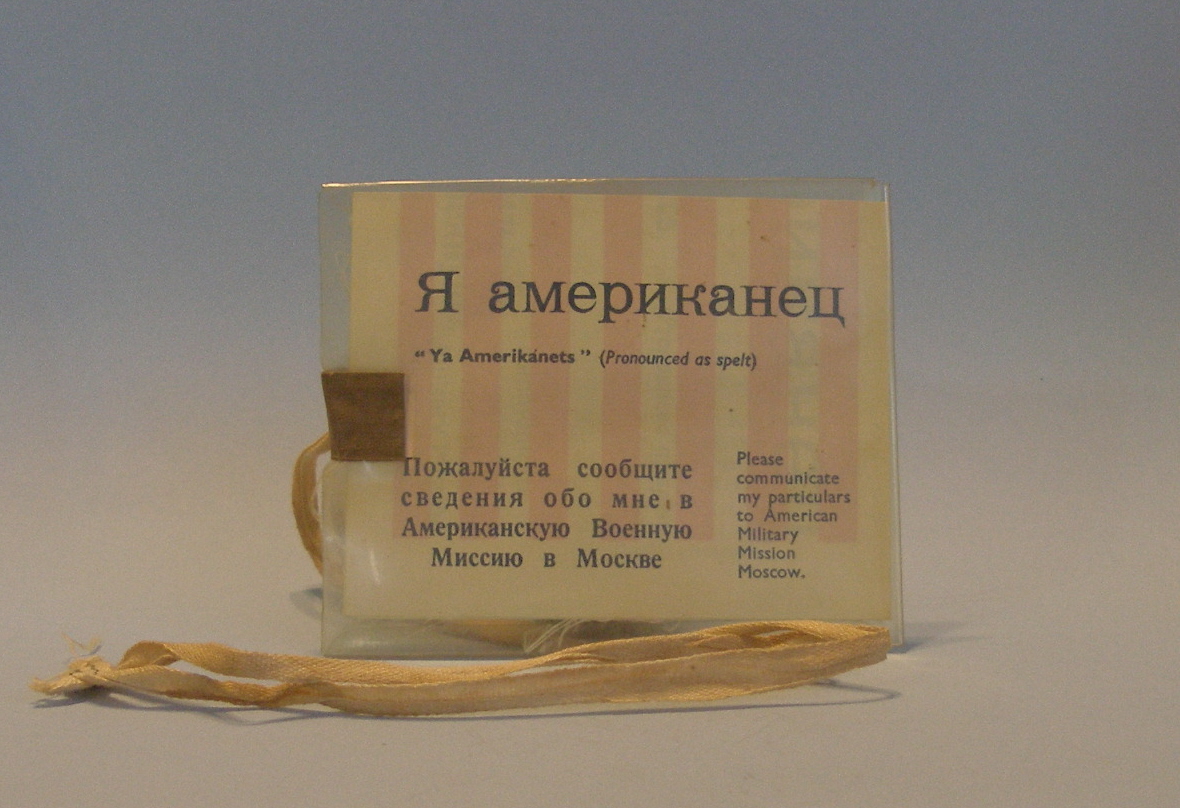
Commonly known as a "blood chit" (link), this item was used primarily by air crews to aid in escape and evasion if shot down behind enemy lines.  My father's blood chit was issued to US Army Air Force flight crews who might fall into Russian hands in order to identify them as Americans.  It is in almost perfect condition and included the heavy-duty plastic sleeve with the "dummy cord" still attached.

"Front" of the blood chit with pronunciation guide for "I am an American" and message to contact the American military mission in Moscow.


"Back" of the blood chit with smaller version of front image/phrases and instructions for using the chit.  Notice the warning in number 5 and the caveat in number 6.

"Front" of chit in the heavy-duty plastic sleeve, with attached "dummy cord"

"Rear" of chit in heavy-duty plastic sleeve, with attached "dummy cord"


According to the Snyder's Treasure web site (link), these chits were made of very thin dense woven rayon and measured approximately 9-1/2" x 7-1/2" when unfolded.  When folded into quarters and put into the plastic sleeve, these chits could be carried in the pocket of the airman's flight suit.  Luckily my father never had to use his!

The first part of this series is here:  link.