Showing posts with label French and Indian War. Show all posts

Tuesday, February 12, 2019

Rangers, Compagnies Franches, and American Indians

I made several additions to my "French and Indian Wars" forces in anticipation of a game on Saturday, February 16.  I guess I needed an incentive to get these figures painted.  They will reinforce my Britannian and Gallian field forces.

The first group are 12 American colonial rangers from the old Conquest line (now made by Warlord Games), packs C and D.  They will join the rangers from packs A and B that I had already painted to form a ranger company.

The figure on the left with the map will actually be a senior officer for my Britannian force.
The second group are Blue Moon's French box from their "Drums in the Ohio Valley" range.  These are rather large figures with a large circular base.  I had to mount them on 1" square bases.  They are a varied lot of Compagnies Franches de la Marine colonial infantry.  Theses units were raised by the French Navy who had jurisdiction over the overseas French colonies.  they join two other previously painted units.

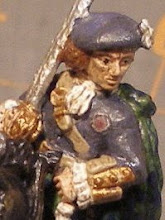
The figure in the tricorne in the center will actually be a senior officer for my Britannian force.
And finally I have a "hand me down" unit of Gallian "courier de bois" (woods runners) and Huron Indians manufactured by Frontier Miniatures which no longer exists (unfortunately to my mind).  The Hurons are armed with bows, muskets, and tomahawks.  Along with their Gallian associates, they will be the Red Rock Clan.  We think that they were painted either by the late Mark "Doc Ord" Stevens or by the late Andrew Doyle.  They were gifted by Mark to my friend Lord Sterling who then gifted them to our friend Steve H.  Not having a need for northeastern woodland Indians, Steve then gifted them to me.  They are mounted on US pennies so I glued them to 3/4" washers to give them some additional height since almost all my French and Indian War figures are 28mm in size.  I still need to do some touch-up painting on their bases.

The Red Rock Clan with their Gallian associates
Here are a couple of close-ups of the figures:

Courier de bois leader

Huron Indians, showing base label
I'll be posting pictures of my game on Saturday at a later date for your enjoyment.


Sunday, December 22, 2013

Some Yuletide Painting

My painting has been going slow these last several months.  I just finished a new unit for my Very British Civil War forces and am working on a new unit for my French and Indian Wars forces.

Very British Civil War

First Section of a company of the Liberty Bell Legion
 The Liberty Bell Legion was formed in the mid 1930s as an adjunct to the more progressive wing of the American Democratic Party.  Initially they were used to raise funds to ensure the election of progressive candidates to the US Congress and to state legislatures.  But when the constitutional crisis broke in Great Britain and the Fascists began to influence the British government, many members of the Liberty Bell Legion traveled to the British Isles to offer their services to oppose the Fascists in the British government.  Organized into independent companies, these volunteers quickly went to various places where more socialist Anglican forces were in control.  One place was the Anglican League command at Bury St. Edmonds, where the 1st Section of the 3rd Liberty Company soon arrived.  The rest of the company are still getting outfitted (painted) and will join them before too many days are past.  They will soon see action as the Spring campaign commences.

These figures are from Falcon (US) Miniatures' Boxer Rebellion line and are US Marine officers and enlisted.  I've had these figures for a number of years.  The impetus for this unit was a flag that Leics_Gamer posted on the Very British Civil War forum of the Liberty Volunteers from New York state.  That was quickly morphed into the Liberty Bell Legion and, as they say, the rest is history (or alternate history, rather).

Banner of the Liberty Bell Legion to be carried by every independent company
I only had enough figures to form 9-man sections instead of the 10 I wanted, so if any American readers of this post have some these Falcon Miniatures Boxer Rebellion American Marines in the advancing pose, please get in touch with me.

French and Indian War

The other figures that I am painting are some of Der Alte Fritz's incomparable Fife and Drum American Revolution militia.  My war gaming buddy Lord Sterling picked these up for me at Historicon back in July.  I finally began painting them.  Although I'm not far along, they are looking rather good.  I'll be using them for a colonial American unit fighting against the dastardly French deep in the backwoods of America.

Part of the militia unit in progress
I hope all my readers have a very nice Christmas holyday and a happy new year.

Saturday, July 9, 2011

Bayou Wars Pictures - Part 3 (Encounter at Fort Fromage)

Well, I finally get the pictures of my game at Bayou Wars edited and posted!  And I can hear nearly everyone say, "It's about time!"

On Saturday morning (June 11 -- one month ago), I ran the Fourth Annual George Carr, Sr. Memorial Colonial game.  This time I set it in the French and Indian War time period with an imaginary encounter between the Gallians (AKA the French) and the Britannians (AKA the British).  I use The Sword in the Forest variant of Larry Brom's venerable The Sword and the Flame rules and troops painted by Mark Stevens and me.  The trees were courtesy of the Brom family.

The situation pitted small Gallian and Britannian forces intent upon seizing the ruins of the old Gallian Fort Fromage in the Fondue Gap through which ran Cheddar Creek.  The Gallians advanced from the north and consisted of the Gallian Regiment Beaujolais (four companies), two companies of Compagnies Gallien, three companies of Canadien militice, two Gallian light guns, and two allied Indian warbands.  The Britannians advanced from the south and consisted of the 5th Foot (three companies), a company each of the 15th and 60th Foot, three companies of provincial regulars, two companies of rangers, light infantry, and allied Indians, and two Britannian light guns.

The figures are a mix of 28mm Dixon, Old Glory, Conquest, former London Warroom (now Dayton Painting Consortium), and a mix of other older manufacturers whom I cannot recall.  But they all blended very well when committed to the Field of Mars.

And now we'll let the pictures tell the story..  As usual, please click or double click on a picture to get a larger image.

The Britannian commanders:  Ed (right wing with Rangers and Light Infantry; Mark (Britannian force commander with Britannian 5th Foot); Charles (left center with Provincial infantry); and Ken (left wing with Britannian 15th/60th Foot).
The Gallian commanders:  Bill (right wing with Compagnies Gallien and Beaujolais pickets); Clay (right center with Canadien militice); Martha (Gallian force commander with Regiment Beaujolais); and Phil (Gallian left wing with allied Indians).
The Britannians get into Fort Fromage first.  Martha consults her combat tables to determine how many troops to throw against them.  Clay and Phil watch as the action develops between Ken and Bill (out of picture to left).
While Charles’ Britannian provincials contest the western hill with Clay’s Canadien militice, Ken’s Britannian infantry begin their long clash with Bill’s Compagnies Gallien.
In the distance, Martha’s Beaujolais infantry assault Mark’s Britannians in the ruins of the fort.  In the foreground, Charles moves additional Britannian provincials against the Canadien militice.  In the far background the Britannian rangers and light infantry begin their fight against the Gallian allied Indians.
Charles and Ken watch the action as the Gallians and Britannians fight over the ruins of Fort Fromage.
Ed ponders his options as the Britannian right wing commander against the sneaky Gallian Indian chief – Phil the Younger.
While Ken and Charles look on with grins, Bill lobbies his commander, Martha, for a fire card for Clay’s Canadien militice.  His infantry are tangled in a melee with Ken’s so he doesn’t require the card.
The action continues and is especially fierce within the ruins of the fort where Britannians and Gallians exchange point-blank range volleys.
While Ed’s rangers and light infantry exchange a volley with Phil’s Indians on the low ground to the left, their other forces fight tomahawk against tomahawk on the wooded hill.  Mark’s gun has fired laterally against the Gallian Indians and he has moved his grenadiers up in support.
Ken’s 60th Royal Americans clash with Bill’s Compagnies Gallien on the other flank while their supporting infantry looks on.
In the foreground, Ed’s command has taken the hill from Phil’s Indians and forced the rest of Phil’s Indians back with several good volleys.  In the background however, Martha’s Beaujolais Regiment has pushed her husband’s Britannians out of the ruins of Fort Fromage, quite a coup for the Gallians.  Now, can they hold it?
Martha repositions her Beaujolais in the fort, ready to resist any further Britannian attacks.  In the background, Ken’s Royal Americans appear to have been beaten by Bill’s Compagnies Gallien.  But Ken is ready to carry on the attack with his 15th Foot.  Between the two actions, Charles and Clay continue to trade volleys on the western hill.
A closer look at the action between Ken and Bill (right side of picture) and Charles and Clay (left side of picture).
Martha’s Gallian Regiment Beaujolais is ready for the Britannians, having been reinforced by some of Clay’s Canadien militice with their gun.  Charles has redeployed some of his Britannian provincials to bring additional firepower to bear on the Gallians.  But do the Britannians have enough force to drive the Beaujolais from the fort?
Ed rearranges his Britannian rangers and allied Indians to consolidate his hold on the eastern hill.
Charles reaches in to reposition some of his Britannian provincials facing Clay’s Canadien militice on the western hill.  Clay looks like his troops have the western hill well in their control.
So, who won?  Each side's mission was to occupy the site of old Fort Fromage and repulse any attempts by the other side to occupy the area.  Additionally each side was to consider occupying one or both of the hills that bordered the pass.  The Gallians had occupied the fort ruins and the western hill, plus they had both of their guns still in action.  The Britannians only occupied the eastern hill and had one of their two guns still in action.  The game master (me, of course) ruled that the Gallians had secured the victory, this time.  In an earlier playtest (see link), the Britannians had won.  So goes the vagaries of (pretend) war.

Sunday, December 20, 2009

Brittanian Corps of Scouts

As described in the previous post about the Charles Town Grenadiers, the Brittanian expeditions into the Hibernian Capitania General de la Florida will always be led by the Corps of Scouts. This "brigade" consists of nine Colonial rangers (foreground in green), seven Brittanian light infantry from the 5th Foot (left middle in red), and the four Colonial Charles Town Grenadiers (background in green with busby).

It is, to my eyes, readily apparent from this picture that the Redoubt rangers, Foundry light infantry, and unknown manufacturer grenadiers match fairly well and, in a skirmish role, can be used together in one unit.


Here the Corps of Scouts encounters warriors from the Soaring Hawk clan (Old Glory Indians)


They trade shots, although everyone's aim appears a little off as there are no casualties.


Charles Town Grenadiers

As promised earlier, here are the "unknown manufacturer's" Queen's Rangers grenadier figures. I will be using them in my imaginary 1760s-ish campaigning in the southeastern portion of North America, what I am calling El Capitania General de la Florida (with thanks to Jean-Louis of the Persipality of Monte-Cristo).


These four figures will be "brigaded" with nine Colonial rangers and seven Brittanian light infantry to form a Corps of Scouts for the Brittanian expeditions into Florida.


Although I have these figures glued to 3/4" (~20mm) fender washers, I think that I will need a slightly larger size, probably 1" (~25mm) washers since their bases are so large.

Friday, December 18, 2009

Rangers and Light Infantry

After finally getting my first war band of Woodland Indians painted, I started on some opponents for them. First up were 9 Redoubt French & Indian War rangers.

I painted them wearing the black with blue facings uniform popular with some of the ranger units during the early part of the war. Although Redoubt sculpted them to be Roger's Rangers, these will just be a generic group until I can decide on a name for them.

Although they look very shiny in the pictures, they do have a matte varnish on them that gives them a warm satiny look. The Redoubt poses were very easy to piant.

They should be excellent opponents for the Gallian allied Indians and the Gallian colonial militia and Compagnes Franches de la Marine that I have.

The rangers will be teamed up with a small group of Foundry British light infantry. Now the actual figures are from Foundry's American Revolution line, but in my imagi-nation New World, they will be so uniformed just a little earlier than in the real-world.

These seven stalwart "Light Bobs" are painted as the light infantry of the 5th Foot, early in the conflict before they became corrupted by the radical ideas of those 'Murican bandits.

As with the Redoubt figures, these were very easy to paint, with the details being clearly defined and readily accessible to a paint brush.

I'm also just about finished with the last contingent of this little command, a squad of 4 'Murican loyalist grenadiers (see previous post for a picture of one of the figures primed). I'm basing their uniform on that of the American Revolution Queen's Rangers. Their picture will be posted shotrly.

Saturday, December 5, 2009

Soaring Hawk Clan

I've just completed the first combat unit of North American Woodland Indians for my mid-Eighteenth Century "colonial" fighting. These actions will pit the Brittanians and their colonial and Indian allies against a shaky coalition of Gallians, Hibernians (AKA Spanish), and Indians. It will be set in the American southeast. Eventually I'll establish a new blog for it separate from this one. But that's for later on. Now, I present the Soaring Hawk Clan.


The first group of 12 warriors is led by Bright Eagle
(center front with musket at trail)


The second set of 12 warriors is led by Crouching Panther
(center front with blue blanket)

The Soaring Hawk Clan will eventually add a clan chief once I get several of my extra Indians converted with added muskets and more "regal" distinctions. The Soaring Hawks wear red and black "war paint" and the handles of their clubs and tomahawks are stained red. This represents the ferocity of the stooping hawk as it strikes its prey.

These figures are Old Glory and were painted with acrylic craft paints, sealed with Future, "dipped" by brush, and then varnished with a matte sealer. The flash on the camera shots tends to give them more of a gloss look that they have "in the flesh," so to speak. It took me a long time to get these painted as I tried to give each warrior his own unique look. I'm hoping that the next ones I paint will go quicker.

Tuesday, June 30, 2009

French & Indian War at Bayou Wars

Last Friday afternoon (June 26), I played in Larry Brom's French and Indian War game, Mayhem in North America, at our regional gaming convention, Bayou Wars. Larry was trying out his convention fast play rules for the first time after a number of play tests with his daughter, Lori (an avid gamer in her own right).

Larry Brom giving out instructions prior to the start of the game.

The scenario was a meeting engagement somewhere in the woods in Pennsylvania or New York between two balanced forces. Each side had two regular infantry units, one light gun, one ranger or couer de bois unit, two militia units, and three Indian units, plus a commander and and a second in command. I played on the British side.


The British commander, gun, and the two regular infantry units (being played by bearskin hatted grenadiers) advance into a clearing between two wooded areas.

For part of Larry's physical therapy after his various heart related illnesses, his daughters purchased a large selection of plastic coniferous and deciduous trees. Larry spent a good amount of time gluing these trees to out-of-date color sample chits and then adding some flocking to them. The overall effect was very nice as it amply simulated the North American wilderness.


A lone unit of British allied Indians advance across a clearing to scout out the French lines.


Seeing the French infantry in the open, the British allied Indians start to swarm them. But the plucky French withstood several Indian charges, although both units lost many fusiliers to the Indian's muskets, arrows, and tomahawks.


The British infantry, on the other hand, thought that it could awe the French couer de bois and militia with its military splendor and advanced up a rise to "teach the Frogs a lesson." The gun and the couer de bois were better shots than the British anticipated - scratch one British unit!


Two of the French allied Indian units try to stay concealed in a patch of woods, waiting for the British forces to come out in the open.


Which they obligingly did, leading with a unit of green clad rangers and following with two militia units.


Meanwhile, the second British regular unit covers the right flank against a unit of French allied Indians deployed along a woodline. (The white ring denotes a casualty.)


The British allied Indians, now joined by a colonial militia unit, continue to harass the French regular infantry units, slowly wearing them down. But the French were also getting their licks in, killing a number of Indians with their disciplined musket fire.


Beset by three enemy units (two militia and one Indian), the British regulars slowly withdraw. On the upper right, the British gun stands deserted as the lone surviving gunner has fled his post.


A British allied Indian unit melees with the French regulars. They inflict some casualties but are forced to withdraw out of effective musket range of the French.


On the British left, the rangers and a unit of militia engage the French allied Indians and begin to force them back.


While on the British right, the French allied Indians have completed circled the British regulars, forcing them to change facing and then charge with cold steel. They are joined by one of their allied Indian units. But the French allied Indians are too ferocious for the British infantry and the second unit is reduced to combat ineffectiveness.
(The stand of four blue coated figures with the three white rings is the single British gunner striving to return to his gun. He makes it but is then shot by French militiamen before he can get the gun into action!)


Finally the British allied Indians are able to get things coordinated and gang up on the French allied Indian unit that defeated the British regulars. They smash the French Indians and send the remnants fleeing the field.

But by then the British had lost too many troops and the French were declared the winners, with a captured British gun to take home as a trophy. Even though I was on the loosing side, I still had fun. The game played very quickly and easily. It should soon be available at Sergeants3.