Wednesday, March 11, 2009

Some Old School Soldiers

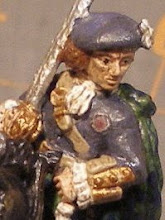
Several days ago, Snickering Corpses, the owner of the Principality of Hesse-Engelburg blog posted some pictures of older 30mm figures that he had acquired to see if anyone could help him identify them. To my surprise, one of them was almost an exact match to an old Scruby 30mm Bavarian Napoleonic figure I had - except mine has a plume on the side of the casque and his didn't. (http://hesse-engelburg.blogspot.com/2009/03/figure-identification-further-photos.html)

Back in the early 1970s I got a sample of Jack's 30mm Napoleonic figures that include a mounted Napoleon, a Chasseur a Cheval of the Guard, and six infantrymen. I painted the six infantry but have never gotten around to the two mounted figures. The infantry grace my cubicle at work and I decided to show them off here.

They are mounted on circular 40mm Litko bases which have had terrain effects added.


Here are the three Coalition figures -- an unidentified light (?) infantryman that I painted in a green jacket and gray pants, a stalwart British center company infantryman, and an early Prussian (I think) musketeer.


And the French and allies -- a French grenadier in bearskin, a French line leger, and a Bavarian grenadier (this is the match to SC's figures).

I had to touch these up before I mounted them as their paint had become chipped over the years. Additionally the British figure had snapped off at the ankles and needed drilling and pinning in both legs. That was a chore, but turned out fine.

Dervishes Finally Finished!

After many weeks of procrastination, I finally finished the last unit of my small Victorian Colonial Dervish force - a unit of 12 mounted spearmen. Shown below with the unit leader (holding flag) and a senior mounted leader, they are venerable 25mm Ral Partha figures. As always, please click on the picture for a larger view.

My Dervish force now consists of three 20-figure infantry units, this 12-figure cavalry unit, two 4-figure gun crews (using whatever guns may be available), and two senior leaders (one mounted and one foot ), plus a prophet. Coupled with my small Beja force of two 20-figure infantry units and one 12-figure camelry unit, this will make a handy army to wreck havoc in the Soudan against the British and their Egyptian lackeys.

Of course I still have to finish with the Egyptians. And then there are the rest of the Bedouin/Berber style Arabs, and the Pathans, and more British, and an Indian lancer unit left to go. So I'm not finished with the Victorian Colonial "lead mountain" yet!

Wednesday, February 18, 2009

The Truce

In anticipation of the visit by F.M. Reichduke Wilhelm von Beerstein (see http://reichduchyofbeerstein.blogspot.com/2009/01/reich-duke-wilhelm-plans-grand-tour.html and http://emperor-elector.blogspot.com/2009/02/reich-duke-wilhelm-departs-on-grand.html ), Major General Campbell, O.T., is arranging a truce between Markgraf Hapnich of Carpania, his employer, and the Dukes of Courland and Sachsen-Wachsenstein.


Duke Pavlov of Courland (green coat) and Duke Siegfried (light gray coat) arrive at Potzdorf, escorted by a troop of the Courland Timofievich Cossacks.


Major General Campbell. O.T., greets the Dukes and introduces them to the Markgraf prior to beginning the truce discussions.

Campbell's Highlanders

As the Markgraf and his entourage watch, the first wing of Campbell's Highlander Battalion marches onto the army drill field just outside the walls of Potzdorf. They have been raised as part of Major General Seamus Campbell's contract for service with the Margraviate of Carpania.


Parading past the royal party outside their marquee.


The Highlanders will be brigaded with the Carpanian converged grenadiers, a battalion of which is drawn up to receive them.


General Baron von Stuppe, the army commander, and Major General Campbell watch as the Highlanders make a complicated maneuver that puts them in front of the Markgraf.


A close-up of the 1st wing of Campbell's Highlander Battalion. They carry the simple St. Andrew's flag and are accompanied wherever they go by the stirring pipes.

The Highlanders are from the Front Rank Jacobite line. The second wing is still being equipped (i.e., being painted).

Saturday, February 14, 2009

Latest Acquisitions

As I sit here at the computer listening to the pipes and drums and military band of the Royal Scots Dragoon Guards, my pulse quickens. Major General Campbell is pleased with his latest acquisitions.

First, as a result of the sale of Dixon figures by FAA-USA Wargames, I've added enough SYW British to complete a good sized battalion of Britannian infantry to augment the allied forces of the Margraviate of Carpania.


This 56-figure battalion consists of a 5-figure color party (officer, two ensigns, and two color guards), one 15-figure grenadier company (officer, sergeant, drummer, and 12 grenadiers), and three 12-figure center companies (each officer, sergeant, drummer, and 9 hatmen).

In addition I obtained a 12-figure squadron of Britannian dragoons and an extra mounted officer.

Say what you will about the "pumpkin heads" of some of the Dixon infantry (and these have them), they are still nice castings and will make a welcome addition to my big battalion SYW troops.

Earlier I got a good buy from eBay. Sixteen Hinchliffe Scots Grays. Although these are Napoleonic vintage (wearing the bearskin cap), they will comprise the mounted portion of the Major General's mercenary band, doing double duty as both SYW era imagi-nation troops and Napoleonic era troops.

They came attached to their horses and on ovalish shaped metal bases that had the basic terrain effect done. And they were primed! As you can see there will be some bracing needed for several of the horses who are either balanced on their rear legs or just on two opposing legs. That will be a fun evolution (he writes with a grimace).

Tuesday, February 3, 2009

Miniature Medal

Alan from the Duchy of Tradgardland made a comment that it would be nice if we could have miniatures of the medals we have either made ourselves or have been awarded by others. I have been pondering that for a while and finally made a try today. I copied the Ancient and Honorable Order of the Tankard from the Reichduchy of Beerstein blog and then opened my copy in MSPaint. I reduced it down to 5% of the original size, which is pretty darn tiny and then printed it on a laser color printer. Using a magnifying glass, I then cut out the miniature medal and glued it to the chest of my figure for Major General Campbell using regular PVA (Elmer's) white glue. Here is the result:


A close-up of Major General Campbell, OT


And a close-up of the miniature medal on his chest.

While it is not very discernable, you can still tell that a medal is emblazoned on the figure. I think it turned out very well. I'll cover it with some matte glaze to help keep it attached and to protect it.

Sunday, February 1, 2009

Old School Wargamer Library

In a previous post, I described getting Wargame Tactics by Charles Grant as a late Christmas present (thanks to an Amazon gift certificate). So I decided to determine what books I had in my personal library that might qualify as "Old School" wargames books. I've come up with at least these six.


The first three are:

Little Wars by H. G. Wells (the 1970 Arms and Armour Press reprint with a forward by one of the deans of science fiction, Isaac Asimov)

The aforementioned Wargames Tactics by Charles Grant (1979 Hippocrene publication)

Charge! Or How to Play War Games by Brigadier Peter Young and Lt. Col. J. P. Lawford (1967 Morgan-Grampian publication)


The next three are:

Scenarios for Wargamers by Charles Stewart Grant (a WRG 1st edition publication)

Setting Up a Wargames Campaign by Tony Bath (the 1978 WRG 2nd edition)

Programmed Wargames Scenarios by Charles Stewart Grant (a WRG 1st edition publication)

I'm sure I have a few others, but these are some of what I consider basic "Old School" wargaming publications.