Monday, May 30, 2022

Breckinridge's Division


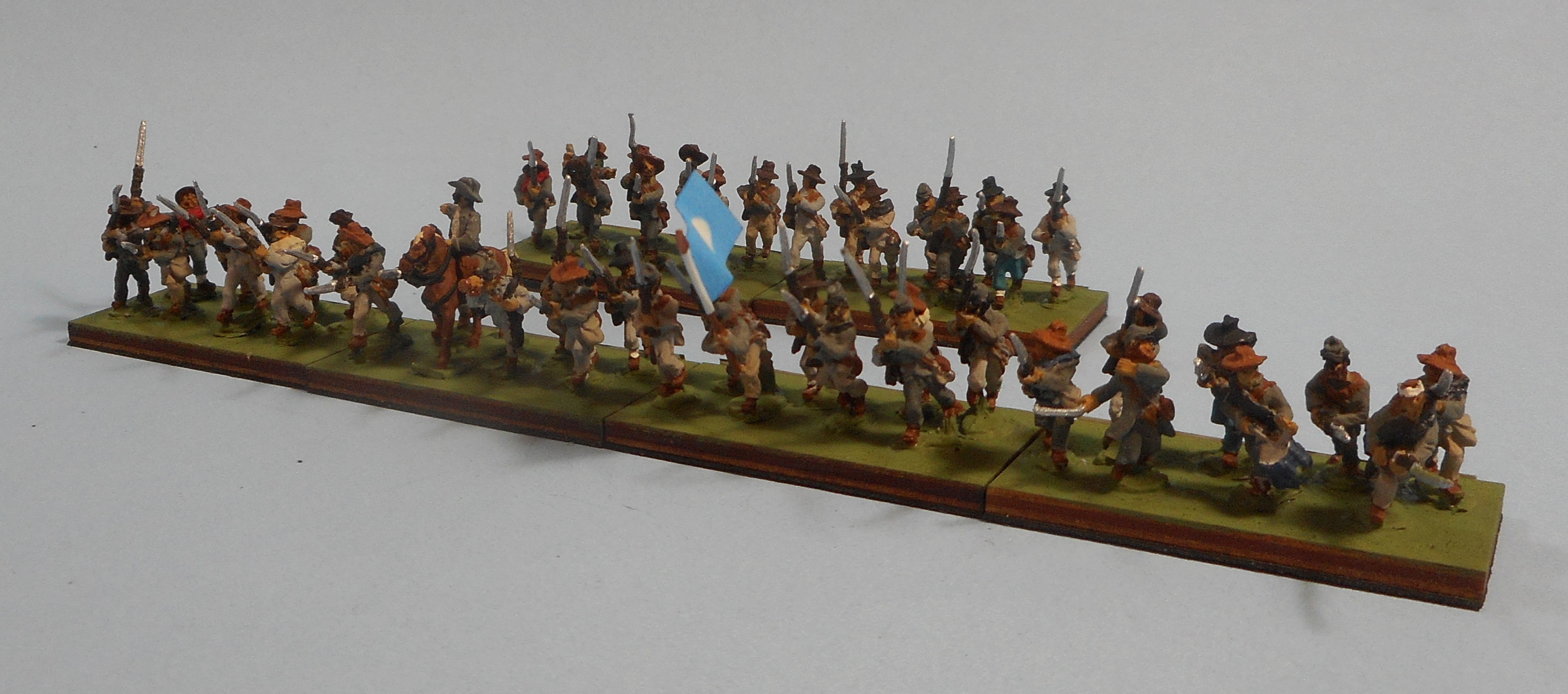
This post shows all of Confederate Major General J. C. Breckinridge's Division of Hardee's Corps.  It was painted by my friend Larry on commission.  He did a great job.

As I've written before, my Confederate forces are loosely organized for Hardee's Corps, Army of Tennessee, during the mid-summer Tullahoma Campaign.

Except for the Battle Honors mounted officers, all the figures and guns are from Old Glory 15s.

Please click on the images for a larger picture.

Division command stand and divisional artillery

Breckinridge and his division flag bearer are on the left and the representation of the division artillery is on the right.

John Cabell Breckinridge was a son of Kentucky and Vice president of the United States under James Buchanan (1857-1861).  He unsuccessfully ran for president as a "Southern Democrat" in the 1860 election that saw Republican Abraham Lincoln elected president.  As one of Kentucky's senators he urged compromise to preserve the union but ultimately failed and fled to the southern controlled portion of Kentucky.  There he was commissioned as a brigadier general in the Confederate Army and then promoted to major general.  During the 1863 Tullahoma campaign his division served under General Joe Johnston in Mississippi against Major General U.S. Grant's offensive.  Recalled to Tennessee, Breckinridge's division participated in the battles at Chickamauga and Chattanooga.  For my purposes, this division did not go to Mississippi but stayed in Tennessee.

Breckinridge's division artillery consisted of three batteries.  Cobb's Battery, or the 1st Kentucky Artillery, started its service with four M1841 6-pound smoothbore guns and two M1841 12-pound mountain howitzers.  By July 1863 it had four M-1857 12-pound Napoleon guns.  Mebane's Tennessee Battery had four 12-pound howitzers.  Slocomb's Louisiana Battery had four 12-pound Napoleon guns and two James rifled guns.  For the purposes of the "On to Richmond!" rules all of these batteries are represented by one smoothbore gun.

Helm's Brigade

Helm's "1st Kentucky" or "Orphan" Brigade

The 1st Kentucky Brigade was originally commanded by Breckinridge.  Brigadier Benjamin Hardin Helm took over command in January 1863 and led the brigade until his death at Chickamauga.  The brigade was called the "Orphan" brigade after its recruiting ground in Kentucky was lost to the Union.  It served with the Army of Tennessee until the end of the war.  For the Tullahoma campaign it consisted of the 41st Alabama and the 2nd, 4th, 6th, and 9th Kentucky Regiments.  With a strength of about 1500 men, it is represented by five stands of figures.

Adams' Brigade

Adams' Brigade

Commanded by Brigadier General John Adams, this brigade consisted of the 32nd Alabama, and the  13th/20th Louisiana, 16th/25th Louisiana, and 19th Louisiana Infantry Regiments, and the  14th Louisiana Sharpshooter Battalion.  With a strength of about 1200 men, it is represented by four stands of figures.

Stovall's Brigade

Stovall's Brigade

Commanded by Brigadier General Marcellus Stovall, this brigade is the smallest of the three in Breckinridge's Division.  For this campaign it consisted of the 1st/3rd Florida, 4th Florida, 47th Georgia, and 60th North Carolina Infantry Regiments.  With a strength of about 900 men, it is represented by 3 stands of figures.

This division completes my Confederate troops for the time being.  Now off they go to battle!


Saturday, May 14, 2022

Bowen's Command Group and Division Artillery


Major General John S. Bowen commanded a two-brigade division in the Department of Mississippi.  While his division was part of Pemberton's "Army of Mississippi," in my "imagi-nation" Civil War it and Forney's Division were transferred to central Tennessee prior to Grant beginning his campaign to take Vicksburg.  His First Brigade was featured in a previous post.  The second brigade (Green's) is being painted.

Bowen's command stand on left and division artillery on right

John S. Bowen began his Civil War career as a commander of Confederate Missouri infantry.  He was promoted to Brigadier General in March 1862 and led his brigade at Shiloh and Corinth before it was assigned to the Vicksburg garrison.  His efforts at Grand Gulf and Raymond led to him being promoted to major general and put in command of a division which he led at Champion Hill and then into Vicksburg.  He died of dysentery after the surrender.  Of course in "my world" his division was transferred to Tennessee and joined Hardee's Corps in the Army of Tennessee after Stone's River.

Bowen's command stand - a Battle Honors mounted general and an Old Glory 15s flag bearer

Bowen's division artillery consisted of three batteries - the Appeal (Arkansas) Battery (two 3" rifles and two 12-lb howitzers) and Guibor's (four 6-lb guns) and Landis' (two 12-lb Napoleons and two 24-lb howitzers) Missouri Batteries.  It is represented as having all smoothbore guns.  In the "On to Richmond!" rules, Confederate gun stands consist of 12 guns.

Old Glory 15s gunners and gun

The rest of the division, Green's Brigade is being painted and will be posted later.  The entire division, as well as all my Union and Confederate troops, will receive their "baptism of fire" in a game next Saturday.


Saturday, May 7, 2022

Cockrell's 1st Missouri Brigade


Cockrell's 1st Missouri Brigade of Bowen's Division has now joined my Confederate forces.  Although it is assigned to Hardee's Corps, this brigade was actually part of Pemberton's "Army of Mississippi" during the spring and summer of 1863, fighting at Champion Hill and the siege of Vicksburg.  Even though formed from Missouri State Guard, it was one of the hardest fighting brigades in the Western Theater.  I decided to modify my order of battle for Hardee's Corps to include this brigade, presuming that it and its companion brigade, Green's, both of Bowen's Division, had been moved from Mississippi to Tennessee to oppose the Union forces there before Grant started his active campaigning to get around the southern flank of the Vicksburg defenses.

The brigade in its "reinforced line" formation.

Commanded by Colonel Francis Cockrell, it consisted of the 1st, 2nd, 3rd, 5th, and 6th Missouri Infantry Regiments.  It was about 1,500 rifles strong in the spring of 1863, translating to five stands for the "On to Richmond!" rules I'm using.  These Old Glory 15s figures are painted in the "drab" uniform with which this brigade was outfitted.  They are mounted on 2" x 1" Litko 8mm bases.

The brigade in march column, showing one of the regimental flags used by Missouri forces.

I tried a different basing technique with this brigade, mixing my Americana Hauser medium green paint with Delta Ceramcoat Texture Builder to try and add some dimension to the bases.  Although it was thick when I applied it, the mixture flattened as it dried.  And it got glossy so I'll need to either put some matte glaze or some more green paint over it.  Oh well,  live and learn.

I also completed enough 'morale markers' for all of the brigades.  "On to Richmond!" uses a system of disrupting morale markers to record the effects of weapons fire and close combat.  I represent these with 1" hex bases and a casualty figure.

Confederate and Union morale markers.

Brigades can accumulate up to three morale markers, represented by the number of dots on each of the three faces of the hex marker.  The more markers received, the less effective a brigade can be.  Brigades with a morale marker must check on the morale table at the beginning of their division's activation even if they will not perform any action.  The brigade must follow the results immediately even if it means the brigade falls back or launches a charge against the nearest opponent.  Makes things interesting as one can never be sure what a 'shaky' brigade might do.

Next up in the painting queue is Bowen's Division command stand and the divisional artillery 'battalion" followed by Green's Brigade.

Saturday, April 23, 2022

Wood's Brigade of Cleburne's Division


This 15mm ACW Confederate brigade has been "hanging fire" for many, many months (since the fall of 2019).  But now its time has come, energized because I need more Confederate forces for my upcoming game at the regional Bayou Wars convention in June.  They are 15mm Old Glory figures and are based for the "On to Richmond" rules.  Please click on the pictures for a larger image.

Wood's Brigade, commanded by Brigadier General Sterling A. M. (Sam) Wood is a mixed Alabama and Mississippi brigade in Major General Patrick Cleburne's Division of Hardee's Corps in the Army of Tennessee.  It is the last of Cleburne's three brigades to be painted.

The brigade consists of the 16th Alabama, 33rd Alabama, and 45th Alabama Infantry Regiments; the 18th Alabama Infantry Battalion; the combined 32nd/45th Mississippi Infantry Regiment; and the 15th Mississippi Infantry Battalion, all told some 1,800 men.

The other units of Cleburne's division are Polk's and Deschler's Infantry Brigades and an artillery battalion (Calvert's Arkansas, Douglas' Texas, and Semple's Alabama Batteries).

I now have six Confederate infantry brigades with two more in the immediate pipe-line.  They'll be fighting against twelve Union infantry brigades.  The game will be a "what-if" scenario from the June 1863 Tullahoma Campaign.  More details to follow.


Friday, April 22, 2022

The Agandar of Chaladoor


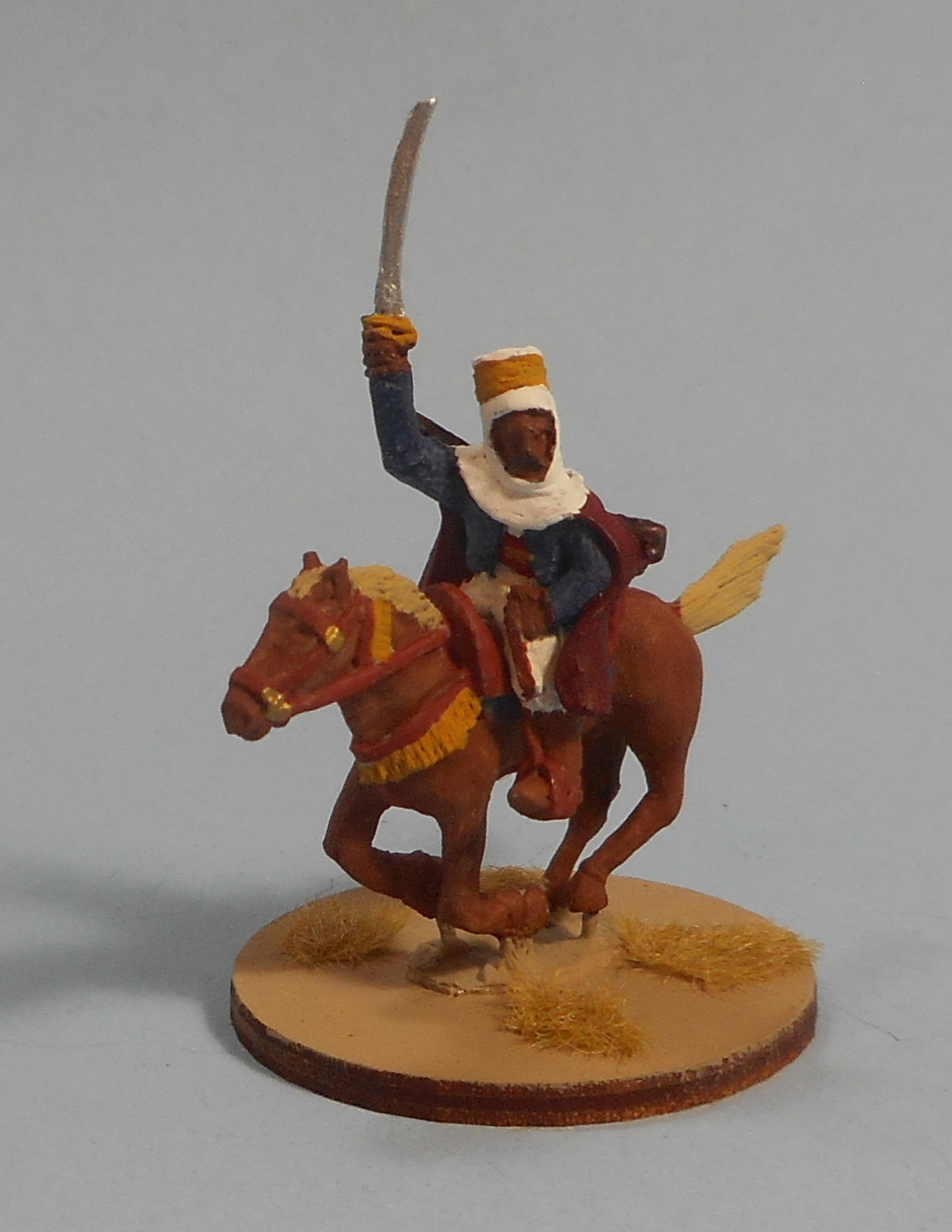
This is my latest colonial figure to be painted.  He is an Askari Miniatures "Berber Cavalry Scout" that is patterned after the famous 'Red Shadow.'  My leader is titled the Agandar of Chaladoor and has, in other guises and with other names, led native forces in Soudan against the Anglo-Egyptians and in the North Central Frontier against the forces of the Raj.  In this guise he will be leading the local tribes of Aooghastan against both the forces of the Khan of the North (the Tsar) and the British Raj.  He is a fearsome warrior who can energize any tribe who he leads.


His name was inspired by the Witches of Karres science fiction novels of James H. Schmitz.  The Chaladoor is a region of far-off space containing a maze of navigational hazards, inimical beings, and disturbing and sometimes violently dangerous forces.  The Agandar is a notorious pirate leader who calls that region home.  Of course my Agandar is not as notorious but nevertheless is a force with which to be reckoned!

Tuesday, April 12, 2022

More Kashgari Falcons and an Indian MG Team

 After a long break due to recovery from laser cataract surgery, I was finally able to get back to painting.

Please click on pictures for a larger image.

My first new unit is an Indian Army Vickers machinegun team.

As with all the other Imperial figures I'm using, these are from Brigade Games WW1 in Africa line.  Since the Indian MG team only came with 3 figures I added a British infantryman to make it up to full strength of four figures for "The Men Who Would be Kings" rules.

The second unit is Detachment Two of the Kashgari Falcons.  They are commanded by Subedar Bahadurjit (Victory of the Brave) Singh.  He was lately wounded in a scrape with the Pashtuns and still carries his right arm in a sling.  These are Brigade Games WW1 in Africa line Indians.


If you will recall for my earlier post about the Kashgari Falcons, their turbans are in my high school colors.

I will be taking a short break from late 19th Century Aooghastan to work on some 15mm Confederate figures for an upcoming game of mine.


Sunday, March 13, 2022

In Support of Ukraine


I don't normally post about current world events on this blog since I created it to showcase my hobby of military miniatures and wargaming.  But in this case I'm going to bend my "rules."

Today my wife and I provided flowers to decorate the sanctuary in our church.  We chose sunflowers, the national flower of Ukraine.  The ribbon was supposed to be blue and yellow but I think that I goofed when telling the florist what I wanted.  Be that as it may, the arrangement was all I expected it to be and garnered a number of supportive comments.


If you desire to contribute to the humanitarian relief effort, may I endorse Presbyterian Disaster Assistance (PDA) as a worthy agency.  You can make donations here.  PDA is the emergency and refugee program of the Presbyterian Church USA and is responding to the conflict with emergency humanitarian aid through partners already on the ground.  PDA has been working with these partners for a number of years.

Thanks you and God bless!