Wednesday, November 28, 2007

My First "BIG" Battalion

I've mounted my first "big" battalion of 24 Sash & Saber Russian infantry. They are mounted on 3/4" Litko bases (with self-stick metal sub-bases) and then onto magnetic movement bases. The individual bases still need to be terrained, but that will come over the coming days.


The mounted officer is a Front Rank Prussian who was "pressed" into service as a Russian.


In my imagi-nations, this battalion will be part of the army of the Duchy of Courland.


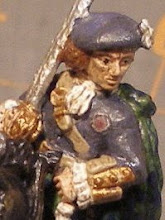
I also tried the "dip" method with these figures. The picture shows a newly painted musketeer (mounted on the nail) and a similar figure after being dipped. The MinWax stain adds a bit of definition to my average painting job and makes the miniature look a little better.


Another battalion of Russians, errr Courlanders, awaits individual bases and then it is on to my Prussians, ummm army of the Duchy of Carpania.

Tuesday, November 27, 2007

My SYW Imagi-Nations

Well, the fat is in the fire, so to speak. Hapnich of Carpania, worried that the Francophile syncophants of Concordia are desiring to encroach upon his domains, has entered into a defensive alliance with the Dukes of Friesland and Grand Fenwick (both Anglophile states). With their combined might, Hapnich now is secure on his throne. Of course, this entire incident has been encouraged by the Baron von Stuppe (a devotee of the Great Friedrich) who, being a first cousin, twice removed, of Hapnich, wants the throne for himself. He wants to get Carpania involved in a war with Concordia and get Hapnich killed on the field of battle. Then he can step into the breach, save the day, and ensure his ascension to the throne of Carpania. Oh what tangled webs we create!

On the other side, Piotr Ustinov, Prince of Concordia, wants nothing more than peaceful relations with all of his neighbors (and plenty of gourmet victuals). Fearful of the behind-the-scenes machinations of von Stuppe, Ustinov has persuaded his cousins, Iago of Campostella, Siegfried of Sachsen-Wachsenstein, and Yakov of Courland, to join his Entente of Concordia to oppose the perceived aggressive nature of the League of Potzdorf.

Both sides are now beginning a mobilization of their military forces. Concordia has just recruited a battalion of foresters, a battalion of infantry, and a squadron of heavy horse, while Carpania has added another dragoon squadron to its already impressive forces. More to come, including pictures, and maybe even separate blogs for the League and the Entente.

Saturday, November 24, 2007

Le Grande Revue - To Be Continued

I'm having difficulties getting my pictures and text to post properly so until further notice my Grande Revue of my 25mm Napoleonic forces will be held in abeyance.

Thursday, November 22, 2007

Le Grande Revue - Part 1

After a summer and fall of campaigning, my Napoleonic forces will soon go into winter quarters. But before they do, and following the example of Der Alte Fritz, I have decided to conduct a grand review of my troops. This will allow me to ensure I have an accurate accounting of the forces that are painted and based, as well as to make some minor repairs to battlefield damage. My Prussian, Russian, and French forces are organized on the August 1813 orders of battle for the Coalition’s Armies of the North and of Silesia and the Grande Armee’s Army of Berlin.

This review is divided into three segments. The first will cover the smallest of the three, the Russians. The Prussians and the French and their allies will be covered in subsequent posts.


The Russians of Corps Winzingerode, consist of the following:

21st Infantry Division, commanded by Generalmajor Laptiev, is represented by the Lithuanian, Petrovsk, and Polotsk Infantry Regiments, using Miniature Figurines figures, in a brigade commanded by Colonel Rosen, and


Heavy Battery No. 12, equipped by 12-lbrs, using older Miniature Figurines figures and guns; and Light Battery No. 11, equipped with 6-lbrs, using older Miniature Figurines figures and guns.


The corps cavalry is represented by:

3rd Cavalry Brigade, commanded by Generalmajor Pahlen, consists of Dragoon Regiments Riga and Finland, both using Scruby figures.

8th Cavalry Brigade is represented by the Mounted Jager Regiment Nijinsk, using Miniature Figurines figures.


Reserve Brigade (fictitious), commanded by Prince Jakov Alexandrovitch Pavlov, is represented by I Battalion, Pavlov Grenadier Regiment, using Der Kriegspieler figures; I Battalion, Finnlandski Guard Jager Regiment, using Der Kriegspieler figures; and Chevalier Garde Cavalry Regiment (with two squadrons of horse grenadiers), using Der Kriegspieler and Scruby figures.

Note: These are some of the oldest metal troops in my Napoleonic armies, having been purchased in the early 1970s while I was in college.

Thursday, October 25, 2007

Flash from the Past

I just ran across this photo showing an early wargame (circa 1972) being played in the wing of my parents house in which my two brothers and I grew up. It is a Napoleonic battle using Scruby, MiniFigs, and Airfix figures and our group's homegrown house rules, with 30-40 man infantry battalions and 30-50 man cavalry regiments.
It's in black and white because we haven't gotten to Oz yet. :^)

Monday, October 8, 2007

IMAGINARY LACE WARS

Like many others have done (and will do), I have translated my interest in the Seven Years War into an alternate reality - using fictional countries as a backdrop for battles during this period. So far I've painted and mounted troops for two of them - the Margraviate of Carpania (ruled by Markgraf Friedrich Hapnich) which uses Prussian troops, uniforms, and flags, and the Duchy of Courland (ruled by Duke Yakov Alexandrovich Pavlov) which uses Russian troops, uniforms, and flags. Other fictional countries for which I have unpainted troops will be the Duchy of Grand Fenwick (British), Principality of Concordia (French), Principality of Campostella (Spanish), Duchy of Sachsen-Wachsenstein (Saxon), and Duchy of Friezland (Hanoverian). All these imaginary countries will be located in the similarly imaginary Kreis of Mittleland (which will occupy the same area as Thuringia in central Germany).

For those of you who are steeped in the names of imaginary movie countries, I'm sure you'll recognize several of the names, especially the Duchy of Grand Fenwick (from The Mouse That Roared) and the Markgraviate of Carpania (from The Great Race).

Here are some pictures of the units I have so far. The first four are from the Margraviate of Carpania and the last is from the Duchy of Courland.


Markgraf Friedrich Hapnich of Margraviate of Carpania
(a Front Rank Frederick the Great figure)


Colonel von Warsteiner, commander of the Warsteiner Grenadier Battalion and proprietor of the Warsteiner FreiKorps. The officer is an old Hinchliffe and the grenadier is a specially commissioned figure offered by Grenadier Books (http://www.grenadierbooks.com/).


1st Battalion of Fusilier Regiment von Stuppe (Front Rank figures).

Freikorps von Warsteiner (Front Rank figures)


1st Battalion, Musketeer Regiment Livlansicher Orden (Sash & Saber figures)

Although these units are ready for gaming, I still have some more work to do on them, such as completing the terraining of the bases and doing some detailed touch-up of the figures.

I'll post more as they become available.

Friday, September 28, 2007

SINK OR BE SUNK!

I just finished reading an interesting volume about the naval actions in the Mississippi Sound between a small American gunboat flotilla commanded by Lieutenant Thomas Ap Catesby Jones and the British armed barges under Commander Nicolas Lockyer sent by Vice Admiral Sir Alexander Cochrane to destroy them.

Sink or Be Sunk! The Naval Battle in the Mississippi Sound that Preceded the Battle of New Orleans by Paul Estronza La Violette (Waveland, Miss., Annabelle Publishing, 2002) is a slim but well written study of how the hydrography of the Mississippi Sound impacted the options of both the American gunboat flotilla and the British forces sent against them. La Violette is a Navy oceanographer and uses his training and experience, especially that of the Sound, to describe the shallows, currents, and winds that worked both for and against both sides.

The American naval presence along the coastal waters of the Gulf of Mexico was miniscule when compared to the might of the Royal Navy that was gathered against them. But American Master Commandant Daniel Patterson used his small squadron (a sloop and a schooner that he kept in New Orleans and five gunboats and two support vessels assigned to Jones) with the experience that he had gained in this area since he was first assigned to New Orleans as a Lieutenant in 1807. His primary subordinate, Lieutenant Jones, was intimately familiar with these waters, having been stationed in New Orleans since May of 1806 as a midshipman. His orders from Commandant Patterson were quite simple – observe, report, delay, and fight.

The story of the British officer, Commander Nicolas Lockyer of HMS Sophie, is just as interesting as that of Lieutenant Jones. He was involved in the disastrous action against Fort Bowyer at Mobile Bay when his ship was damaged and another British ship was lost to the American guns. Lockyer was determined to succeed in his mission of destroying the American gunboats in order to restore his good name. His energy and competence, coupled with his good instinct for the proper tactics, were deciding factors in the British victory.

When the two men finally engage in battle, La Violette’s descriptions of the fighting rival those of C.S. Forester.

The Battle of St. Joe Pass, December 14, 1814, was a tactical defeat for the Americans. But like Benedict Arnold’s naval battle on Lake Champlain during the American Revolution, the delay Jones inflicted on the British timetable allowed General Jackson just enough time to assemble his scattered forces, build his defensive line at the Chalmette Plantation, and eventually defeat the vaunted British Army.

I commend this volume to those interested in both a fight against stiff odds and in the early traditions of the American Navy.